









Artificial Intelligence is no longer the future—it’s the present of education. From solving math problems to writing essays, tools like ChatGPT, Grammarly, and Khan Academy are transforming how students learn.
But this transformation raises an important question:
👉 “Is AI actually making students smarter—or just more dependent and lazier?”
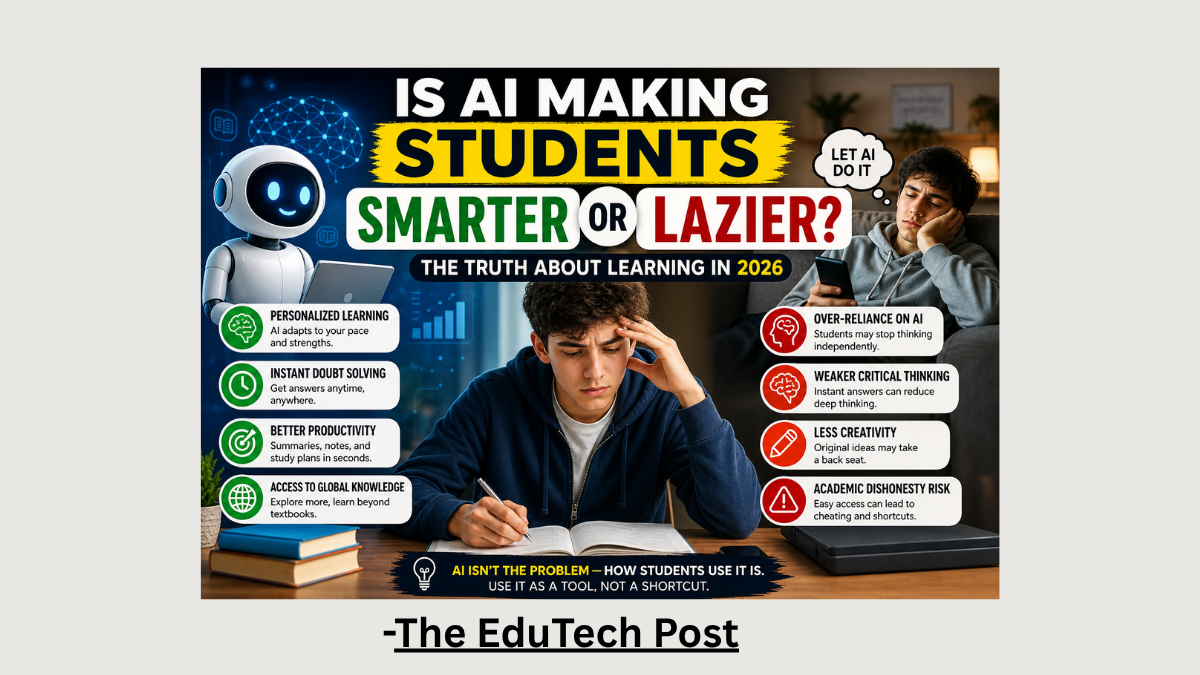
The answer isn’t simple. AI is both a powerful learning companion and a potential shortcut that can weaken critical thinking—depending on how it’s used.
Let’s break down the reality.
🧠 How AI Is Making Students Smarter
1. Personalized Learning Like Never Before
AI tools adapt to each student’s pace, strengths, and weaknesses. Platforms like Duolingo and Coursera provide customized learning paths that traditional classrooms often can’t match. Students understand concepts faster and retain information longer.
2. Instant Doubt Solving
Gone are the days of waiting for teachers or tutors. AI provides 24/7 assistance.
Example:
- Solve math problems instantly
- Get essay feedback within seconds
- Clarify complex topics anytime
This improves learning efficiency and confidence.
3. Better Productivity & Time Management
AI tools help students:
- Summarize long chapters
- Generate study notes
- Create revision plans
This allows students to focus on understanding rather than memorizing.
4. Access to Global Knowledge
With AI, students are no longer limited to textbooks. They can explore:
- Real-world examples
- Updated information
- Multiple perspectives
This expands critical thinking and awareness.
⚠️ How AI Might Be Making Students Lazier
1. Over-Reliance on AI Tools
Many students now:
- Copy AI-generated answers
- Skip problem-solving steps
- Avoid deep thinking
This leads to surface-level learning.
2. Reduced Critical Thinking Skills
When AI provides instant answers, students may stop:
- Analyzing problems
- Asking deeper questions
- Exploring alternative solutions
Over time, this weakens independent thinking.
3. Decline in Creativity
If students rely heavily on AI for:
- Writing essays
- Generating ideas
They may struggle to develop original thinking and creativity.
4. Academic Dishonesty Concerns
AI tools make it easier to:
- Complete assignments without effort
- Generate entire projects instantly
This raises serious concerns about ethics in education.
⚖️ The Truth: It Depends on HOW Students Use AI
AI itself isn’t the problem—the usage is.
✅ Smart Use of AI:
- Learning concepts step-by-step
- Using AI as a guide, not a shortcut
- Verifying and analyzing answers
❌ Poor Use of AI:
- Copy-pasting answers
- Avoiding effort
- Using AI to “finish work” instead of learning
👉 In simple terms:
AI can either be a teacher—or a shortcut.
👉 🎥 Watch: Can AI Make Students Smarter Without Making Them Lazier?
🎓 What Educators Are Saying
Many educators believe AI should be:
- Integrated into learning
- Used as a support tool
- Balanced with traditional methods
Schools are now:
- Designing AI-aware assignments
- Encouraging critical thinking
- Teaching students how to use AI responsibly
🚀 The Future of Learning with AI
The future isn’t about banning AI—it’s about adapting to it.
We are moving toward:
- AI-assisted classrooms
- Skill-based education
- Real-world problem solving
Students who learn how to use AI effectively will have a major advantage.
💡 Final Verdict
So, is AI making students smarter or lazier?
👉 Both are possible.
- Used wisely → AI boosts intelligence, efficiency, and learning
- Used poorly → AI creates dependency and reduces thinking skills
The real question isn’t about AI—
👉 it’s about how students choose to use it.
AI is reshaping education in ways we never imagined. It has the power to democratize learning, improve productivity, and make education more accessible.
But like any powerful tool, it comes with responsibility.
👉 The students who succeed in 2026 and beyond will not be those who avoid AI—
but those who master it without losing their ability to think independently.
Also Read: Study Smarter, Not Harder: The Science of Audio-Based Revision