










You’re unlikely to have missed Nvidia’s big reveal of DLSS 5 at GTC 2026 this week, as it caused quite some waves. Indeed, it’s not an understatement to say that a tidal wave of bad feeling swept across the internet – from Bluesky to Reddit to X – after Nvidia showcased its plans for a new “real-time neural rendering model” that polishes up lighting effects to an eye-opening degree.
Such was the graphical reckoning aimed at Nvidia that CEO Jensen Huang felt compelled to take gamers to task over their attitude. I’m not sure about the wisdom of the head-on way Huang tackled the many DLSS 5 skeptics and detractors. But nonetheless, we’ve seen these kinds of clashes between Nvidia and gamers with DLSS before — more than once, in fact. And history suggests that Team Green will win over the naysayers eventually.
Let’s look at the key complaints gamers have about DLSS 5 – I’ve picked out three critical stumbling blocks – and the ins-and-outs of how valid those concerns are, while turning to said history lesson.
Article continues below
‘Thanks, I hate it’ reason 1: gamers just don’t like how DLSS 5 makes games look
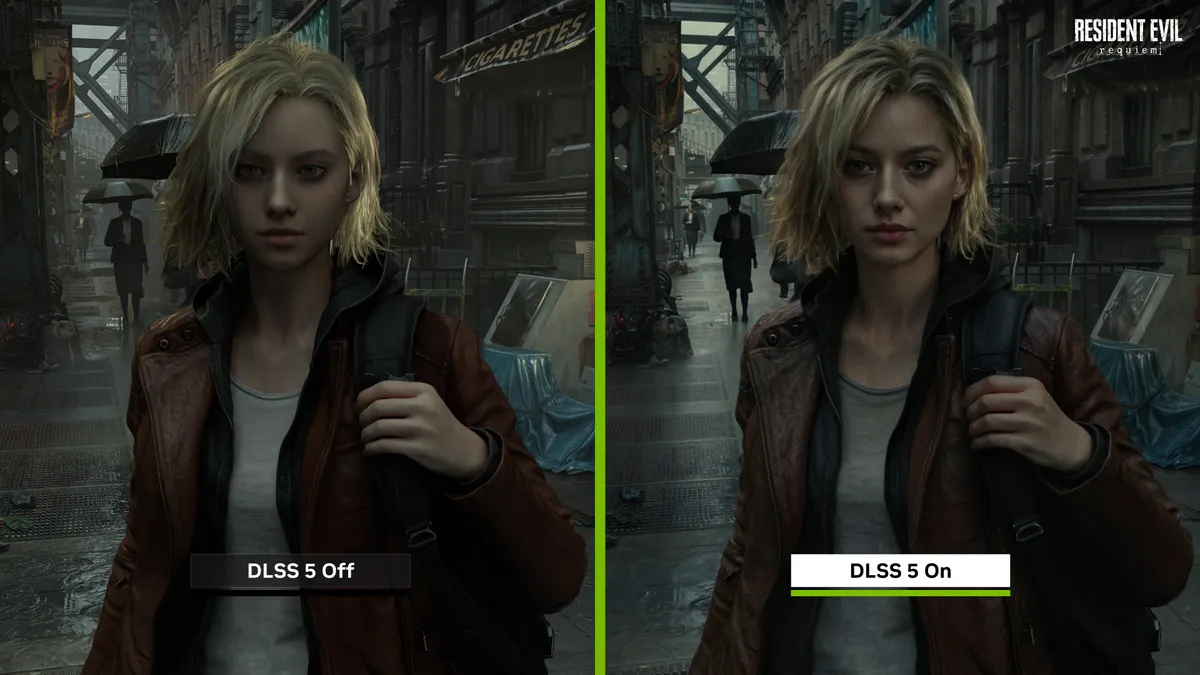
Much of the hatred that’s been spilling forth on internet forums is due to the look DLSS 5 gives games in the sample screenshots shared by Nvidia (and video footage from Digital Foundry). Many gamers simply prefer the original graphics in those before-and-after comparative screenshots, and hate the effects applied by DLSS 5.
A central problem here is the faces of characters looking unreal and, well, AI-generated (or to put it less subtly, as many did: “yassified, looks-maxed freaks”). It should be noted that DLSS 5 does not leverage generative AI from scratch, because as Nvidia has gone to great pains to point out, the game assets aren’t changed by AI — only the lighting. It’s about polishing what’s already there in the game (although there’s some skepticism about that, which I’ll return to later).
It’s not just the ‘uncanny valley’ effect that’s an issue here, though, as some people feel that the overall look of games with DLSS 5 applied is just too sharp, overly bright, and the colors are oversaturated, all of which adds up to an unnatural image — even though the aim is to produce photorealistic graphics, of course.
In short, the end result looks like it’s AI generated, as it’s all ‘too much’ in these respects. Or that’s the feeling of many, summarized into two words we all knew were coming in a lot of the reaction here: AI slop. (Or indeed: ‘Deep Learning Super Slop’).
There are further concerns about glitches and artifacts introduced by DLSS 5, too, as evidenced by some of the (very limited) footage of games actually in motion.
‘Thanks, I hate it’ reason 2: this is messing with the art direction and ambience of games

This piece of flak follows on directly from the above point, but is more about DLSS 5 warping the very feel and fabric of a game.
Resident Evil Requiem was certainly seized on as a case in point here — it’s supposed to feel gritty and bleak, but that vibe is markedly altered by Nvidia’s AI makeover, so it loses some of the dark atmosphere.
This goes beyond the application of lipstick to Grace, and alters the background lighting and its effect and relation to the whole horror theme. There are many criticisms along these lines, and I can absolutely see where they’re coming from.
‘Thanks, I hate it’ reason 3: Nvidia’s just trying to force gamers to upgrade their GPUs

Another element of bad feeling I’ve seen is that DLSS 5 is also about Nvidia selling more graphics cards. Granted, this isn’t nearly as prevalent a beef as the previous two issues, but it’s still a sticking point for some.
The broad assertion stems from this early demo work with DLSS 5 being run on a pair of RTX 5090 GPUs. Yes, not one, but two Blackwell flagships, with one of those graphics cards running the game itself, and the other applying DLSS 5 on top.
This has led to some leaps to conclusions about how demanding DLSS 5 will end up being when the tech is released later this year, and how it’s going to make lesser RTX 5000 GPUs sweat. So, the accusation is that this is a way Nvidia can push gamers to buy a new graphics card — assuming they want to use DLSS 5 at all, mind.
Cutting Nvidia some slack — and a history lesson
A lot of these criticisms are fair enough, I feel, although some more than others. I think the last point regarding the necessary GPU power is a misjudgement, though — Nvidia has made it clear that the final implementation of DLSS 5 will run on a single graphics card. Well, of course it will. Team Green could hardly bring this out if it didn’t work okay on a single GPU (and presumably away from 4K resolution, it’ll be less demanding, too).
How it might work on Nvidia graphics cards below the RTX 5080, though, or whether DLSS 5 is more designed looking towards the RTX 6000 range in terms of more mainstream usage is another matter — granted, those kinds of doubts remain about where this tech will land. Overall, we’ve got to assume that Nvidia knows what it’s doing scheduling this launch for later in 2026.
More broadly, we must remember that DLSS 5 is still in ‘early preview’, which suggests a lot more honing is still to come. This is why two flagship GPUs are needed at this point, and doubtless why we’re seeing some glitching — or overly heavy-handed implementations of the AI-powered lighting effects. The launch incarnation of DLSS 5 is likely to take a lighter-touch approach, I’d guess, especially given the reaction to this sneak peek at the tech. Nvidia has time to adjust and calibrate here, and I’d expect this to happen.
What’s more of a worry for me is the whole nest of issues around changing the art direction or vibe of a game — although Nvidia has stressed very much that developers will have control over the end result with DLSS 5. CEO Jensen Huang defended the tech as ‘content-control’ using AI, meaning that DLSS 5 just polishes existing assets without changing them (as opposed to it being AI generation from scratch).
There are arguments about that too, as looking at the example screenshots shared, some people just don’t believe the feature isn’t messing with the graphics beyond merely applying fresh lighting. However, as Wccftech reports, a veteran game artist has made it clear how changing lighting radically can alter the look of a character more than you’d imagine. The same artist observed that ‘most’ of those raining down flames on DLSS 5 really don’t know what they’re talking about in terms of how the technology works.
That said, others in the industry, particularly certain devs, have come down hard on what Nvidia’s doing here — and pointed to a disconnect between Team Green and some developers.
As we stand here, right now, we have to hope that Nvidia’s promises about the level of control that developers should be able to exercise over DLSS 5 will come good — and that the final implementation of the tech will be quite different to the early sampling we had at GTC 2026. And here’s where the history lesson comes in.
Remember when DLSS was first introduced? It was roundly pilloried for the blurriness and glitches which were the baggage that came with the initial incarnation, and many gamers rebelled and felt that the frame rate increase was not worth this graphical trade-off. DLSS 1 took a lot of serious flak on this front, but by DLSS 2 – when Nvidia brought in temporal (not spatial) upscaling – Team Green fixed those issues, and gamers flocked to the tech.
Still rewinding the DLSS tape, just not as far, remember when frame generation was first tabled with DLSS 3? That particular motion from Nvidia was largely rejected and the whole ‘fake frames’ controversy erupted — and while that’s still a catchphrase floating around online forums today, the overall view of frame gen has changed radically. Nvidia improved frame generation considerably with DLSS 3.5, and today, it’s regarded as a good thing (TM), albeit with caveats (naturally) about how far you can push this AI trickery.
The likelihood, then, is that even if DLSS 5 is shot down upon its initial release, Nvidia will forge on with the feature and get it right. That might take until the next incarnation – DLSS 5.5, or DLSS 6, perhaps on RTX 6000 GPUs – but odds are it’ll happen. I think people tend to forget that plenty of gamers were sure the original DLSS was a ‘dumpster fire’ that wasn’t going anywhere, and they turned out to be very wrong. I most certainly wouldn’t write off DLSS 5 yet.
Getting photoreal

All that said, I’m aware that DLSS 5 is a very different angle to what Nvidia has previously done. The technology is not about faster frame rates and smoother gaming – whether via upscaling, or artificially generated frames – the premise of this latest take on Nvidia’s tech is making games photorealistic. And there’s another question that keeps popping up therein: do we actually want photo-realism for our gaming?
Maybe not. Certainly some folks are vehemently opposed to the drive for photorealistic graphics. They want style and character in their gaming visuals, not hyper-realism. This is where we get into very subjective territory, mind.
Of course, ultimately developers don’t have to use DLSS 5. And even if they do, gamers don’t have to enable it. Although even those who swear off the tech totally, and will never use DLSS 5, will still feel irritation at the path Nvidia is taking here. Mainly because they’ll doubtless wonder what the resources being ‘squandered’ on traveling down this road could have achieved if turned towards what could be perceived as more productive ends.
Nvidia has a tough battle ahead to gain acceptance for DLSS 5, that’s clear enough, but I wouldn’t underestimate Team Green given what’s happened in the past.
The best graphics cards for all budgets
Follow TechRadar on Google News and add us as a preferred source to get our expert news, reviews, and opinion in your feeds. Make sure to click the Follow button!
And of course, you can also follow TechRadar on YouTube and TikTok for news, reviews, unboxings in video form, and get regular updates from us on WhatsApp too.