









- Drone warfare is forcing armies to rethink battlefield casualty evacuation procedures completely
- The UNEX robot removes soldiers from extremely dangerous frontline rescue missions
- American troops are testing robotic evacuation systems during large military exercises overseas
The arithmetic of risk on a modern battlefield has shifted dramatically, and commanders are now rewriting long-standing evacuation protocols.
A drone-saturated environment turns any human-crewed medical vehicle or litter team into a magnet for enemy observation and precision fire, even from a beginner drone operator.
The fundamental problem is no longer just reaching a casualty under suppressive fire but doing so without multiplying the number of lives exposed to an overhead threat that never blinks.

A new calculus for battlefield rescue
Army evaluations in Europe are pushing a specific unmanned ground vehicle (UGV) into the high-stakes battlefield equation.
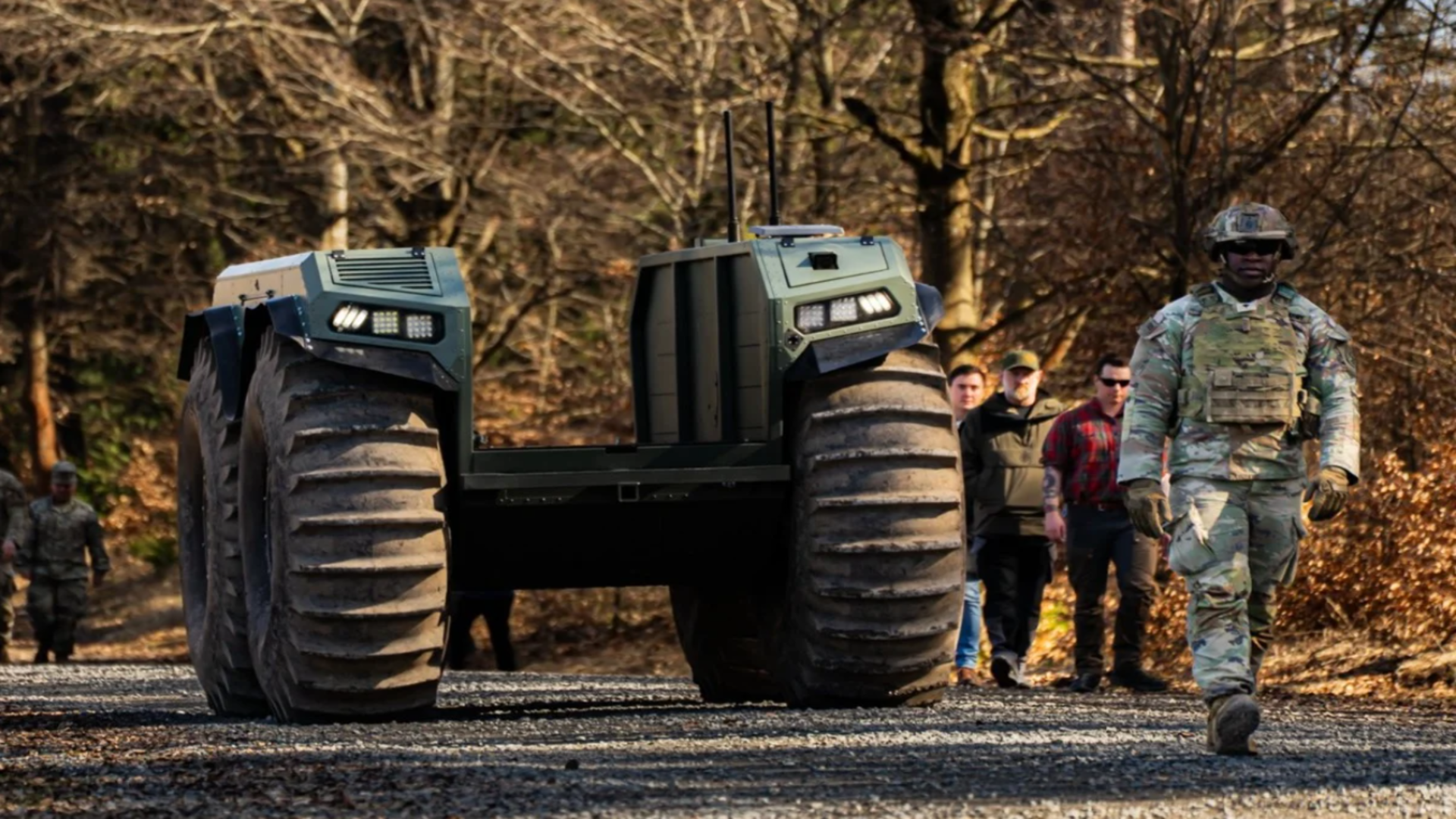
Soldiers assigned to 2d Squadron, 2d Cavalry Regiment are practicing medical evacuation procedures with the UNEX unmanned ground vehicle at Project Flytrap at Pabradė Training Area in Lithuania.
The exercise, which runs from late April through the end of May 2026, fuses counter-unmanned aerial systems with AI-enabled command networks and robotic ground platforms across a linked series of drills.
This training aims to enable soldiers to move faster, decide faster, and fight more effectively without pausing for disconnected systems to catch up.
The UNEX itself emerged from Ukrainian design requirements and carries characteristics that challenge traditional assumptions about medical evacuation platforms.
It operates as a fully electric and amphibious vehicle, which means it can cross water obstacles that would halt conventional ground ambulances.
Its obstacle-handling capability extends to one-meter barriers, and its modular architecture permits integration with mission-specific payloads that shift as battlefield conditions demand.
Earlier American testing subjected the platform to remote drone deployment scenarios and towing of Joint Light Tactical Vehicles.
These operational profiles help reveal whether advertised versatility holds up once a system leaves a scripted demonstration environment.
From Ukrainian design to American testing
The UNEX is now gaining additional traction after winning the XTech Edge Strike Ground Competition in Vilseck, Germany, further opening procurement pathways.
Judges cited four factors that differentiated the system: high mobility, amphibious capability, payload capacity, and operability from a Ground Control Station at extended distances.
That outcome granted ABRIS DG, working through American partner Mountain Horse Solutions, access to a ten-year contract channel on the Global Tactical Edge Acquisition Directorate marketplace.
The distinction moves the platform from a competition finalist into a procurement environment with a direct line to future Army contracting opportunities.
What makes this procurement development significant is the specific mission set that the UNEX is being evaluated to perform.
A robotic casualty evacuation platform fundamentally alters the risk calculus because it removes the medical crew from the most exposed segment of the retrieval task.
An unmanned system navigating to a wounded soldier and returning to a treatment point denies adversaries the chance to inflict secondary casualties during extraction.
Integrating this specific use case into a counter-UAS framework alongside AI command and control shows what the Army expects future close combat to resemble.
However, the usefulness of robotic casualty evacuation systems may ultimately depend on whether they can operate reliably after adversaries disrupt battlefield communications and navigation networks.
Via Defence Blog

Follow TechRadar on Google News and add us as a preferred source to get our expert news, reviews, and opinion in your feeds.