




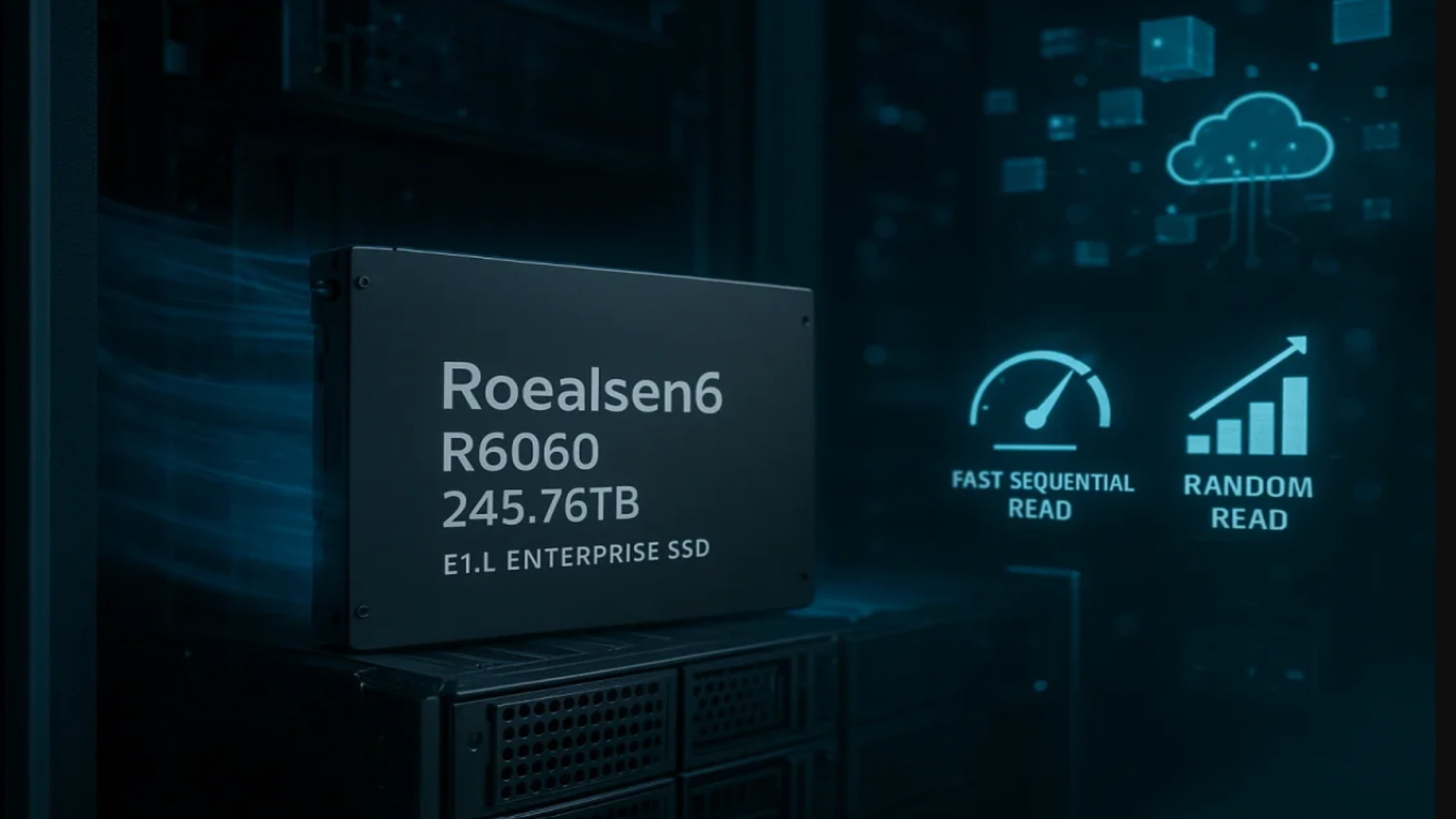





- Four DapuStor Roealsen6 R6060 drives now deliver a full petabyte of storage
- Read speeds remain strong while write limitations become more apparent
- Fewer physical drives reduce rack space, power consumption, and overall infrastructure complexity
Projections made in 2025 that SSD capacities could reach around 246TB by the end of 2025 are now materializing, with DapuStor’s latest drive meeting expectations.
The DapuStor Roealsen6 R6060 offers 245.76TB capacity in a single E1.L form factor and sustains the “doubling trend” moving from 61.44TB to 122.88TB and now to nearly 256TB equivalents.
This scale means only four such drives are required to reach a petabyte of storage, which greatly alters how data centers approach physical space and infrastructure planning.
Article continues below
Petabyte-scale storage with fewer drives
The drive relies on PCIe Gen5 connectivity and a 16-channel controller, reaching up to 14,000MB/s sequential read throughput and approximately 2.1 million IOPS for random reads.
These figures align closely with measured results, suggesting that the advertised specifications are not exaggerated in this case.
However, the architecture depends on eQLC NAND and limited onboard DRAM, which introduces trade-offs that become more visible as capacity increases.
This SSD is compatible with systems such as Ubuntu, Windows Server, and VMware ESXi, which implies that it targets deployment in large-scale environments rather than individual use.
The Roealsen6 R6060 is designed primarily for read-intensive workloads, and this design choice shapes its overall behavior.
Sequential read performance slightly exceeds official figures, reaching over 14,000MB/s during testing, while sequential write speeds remain around 3,600MB/s.
Random read operations also perform strongly, particularly under 4K and 8K workloads, where the drive delivers near its rated limits.
Write performance, however, does not scale in the same way. As capacity increases, the indirection unit grows larger, which reduces both endurance and write efficiency.
This limitation is acknowledged within the broader category of QLC-based enterprise storage, where fast retrieval takes priority over sustained write-heavy operations.
As a result, workloads involving frequent random writes are not the intended use case, and their performance appears comparatively constrained.
Despite the density of the E1.L form factor, thermal behavior remains relatively controlled under sustained workloads.
Testing shows peak temperatures of about 51°C using air cooling, which suggests that cooling requirements are manageable even under continuous stress conditions.
This is notable because compact enterprise drives often face thermal challenges that affect stability and performance consistency.
Since the high-capacity drive reduces the number of physical units required in a rack, total power consumption per petabyte will be lower, reducing cost.
The R6060 reflects a shift in enterprise storage priorities, where capacity and retrieval speed are more critical than balanced performance across all workloads.
Via TweakTown
Follow TechRadar on Google News and add us as a preferred source to get our expert news, reviews, and opinion in your feeds. Make sure to click the Follow button!
And of course you can also follow TechRadar on TikTok for news, reviews, unboxings in video form, and get regular updates from us on WhatsApp too.