









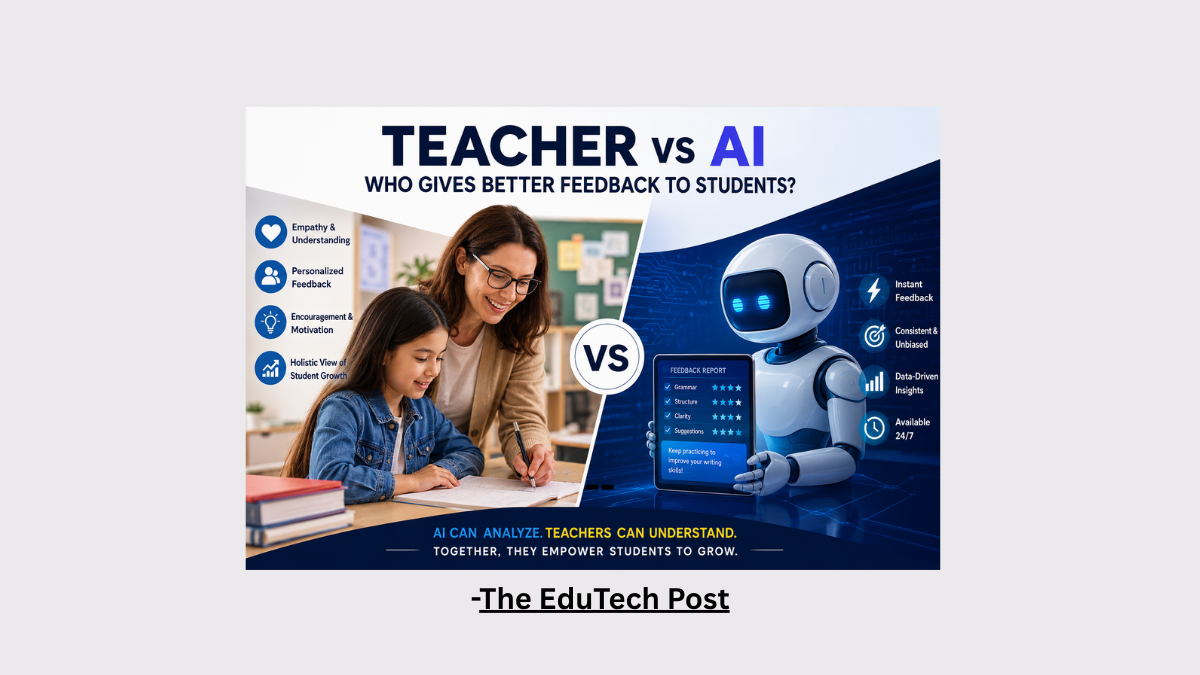

Artificial intelligence is rapidly changing classrooms around the world. From automated grading tools to AI-powered tutoring systems, technology is becoming a larger part of the learning experience. While these tools can save time and provide instant responses, they have also sparked an important debate: Teacher vs AI feedback—which one actually helps students learn better?
As schools explore new ways to use AI, educators, parents, and students are asking whether technology can truly replace the value of human feedback. The answer is more complex than many headlines suggest.
Why Feedback Matters in Learning
Feedback is a strong influence on student achievement. It helps learners understand what they are doing well, where they need improvement, and how they can reach their goals. Effective feedback is not simply about identifying mistakes. It guides students toward deeper understanding, encourages reflection, and motivates them to keep improving.
This is where the debate over teacher vs AI feedback becomes particularly important. While both can provide valuable insights, they do so in very different ways.
How AI Feedback Works
AI-powered educational tools analyze student responses using algorithms trained on large amounts of data. These systems can:
- Grade quizzes and assignments quickly
- Identify common errors
- Suggest corrections
- Provide instant responses
- Track student progress over time
The biggest advantage of AI feedback is speed. Students no longer need to wait days for results. In many cases, they receive suggestions within seconds. This immediate response can be especially useful for practice exercises, language learning, mathematics, and standardized assessments.
As AI continues to improve, schools are increasingly adopting these tools to support teachers rather than replace them.
The Strengths of Teacher Feedback
Although AI can process information rapidly, human teachers offer something technology cannot fully replicate: understanding. Teachers know their students as individuals. They comprehend different learning styles, classroom dynamics, emotional obstacles, and personal strengths. When providing feedback, teachers often consider factors that extend beyond a single assignment. For example, a teacher may recognize that a struggling student has actually made significant progress compared to previous work. This broader perspective allows feedback to become more meaningful and motivating.
In the discussion of teacher vs AI feedback, this human element remains one of the strongest arguments in favor of educators.
Can AI Understand Creativity?
One area where AI still struggles is assessing creativity.
Consider a student writing a personal essay, completing a project, or providing a creative solution to a problem. The work may not follow predictable patterns. AI systems typically rely on predefined criteria and existing data. While they can identify grammar errors or structural issues, they may struggle to appreciate originality, humor, emotional depth, or unique thinking. Teachers, on the other hand, can recognize creative risk-taking and encourage students to develop their ideas further.
As education increasingly focuses on critical thinking and innovation, this distinction becomes even more important.
The Role of Emotional Intelligence
Learning is not purely academic. Students often face stress, anxiety, lack of confidence, and personal challenges that affect performance. A teacher can notice these signs and adapt feedback accordingly. A simple comment such as “I can see how much effort you put into this” can significantly boost a student’s motivation.
AI may generate supportive language, but it does not truly understand emotions or classroom relationships. This emotional connection is one reason why many experts believe human educators will remain central to the learning process.
What Research Suggests
Research consistently shows that personalized feedback improves learning outcomes.
Organizations such as UNESCO and the OECD have emphasized that AI should be used responsibly to support educators rather than replace them. As schools adopt AI technologies, experts continue to stress the importance of maintaining human oversight and meaningful teacher-student interactions.
Rather than viewing the debate as teachers versus technology, many researchers advocate for a collaborative approach where each contributes its strengths.
Where AI Feedback Excels
To be fair, AI offers several benefits that teachers may find difficult to match at scale.
Instant Responses
Students can receive feedback immediately, helping them correct mistakes before misconceptions become permanent.
Consistency
AI applies the same criteria across large numbers of assignments, reducing variation in grading.
Data Analysis
AI systems can detect hidden learning patterns.
Scalability
Large classes can benefit from automated support when teacher workloads become overwhelming.
These advantages explain why AI is becoming an important educational tool worldwide.
Why Teacher Feedback Still Matters More
Despite technological advances, many educators argue that feedback is most effective when it combines academic guidance with human understanding.
Teachers can:
- Adapt comments to individual students
- Encourage persistence and confidence
- Recognize growth beyond test scores
- Understand context and circumstances
- Support creativity and critical thinking
These qualities are difficult for AI systems to replicate. When comparing teacher vs AI feedback, the evidence suggests that AI can enhance learning efficiency, but teachers remain better positioned to provide meaningful developmental feedback.
The Future: Teachers and AI Working Together
The future of education is unlikely to involve a complete replacement of teachers by AI. Instead, many schools are moving toward a hybrid model. AI can handle repetitive tasks such as grading routine assessments, tracking progress, and generating preliminary feedback. Teachers can then focus on mentoring, discussion, creativity, and personalized support.
This partnership allows educators to spend more time doing what they do best: helping students grow as learners and individuals.
Watch: Will AI Replace Teachers? Experts Weigh In
Final Thoughts
The debate over teacher vs AI feedback is not really about choosing one over the other. AI brings speed, efficiency, and valuable data insights. Teachers bring empathy, context, creativity, and human connection.
As classrooms continue to evolve, the most effective learning environments will likely combine the strengths of both.
Technology can help students learn faster, but meaningful human feedback remains one of the most powerful tools in education. For now, and perhaps for the foreseeable future, teachers continue to provide something AI cannot fully replicate: genuine understanding.
Also Read : Is AI Enhancing Learning or Replacing Traditional Education?