











Walk into almost any grocery store and, chances are, what you see in the fish case is not at peak freshness.
You wouldn’t think it’d be that way, especially in places like Seattle, where I live, because such care is given to getting the fish to market quickly. But according to a new venture-backed startup named Shinkei, the critical factor in determining freshness is not what happens after fish leave the boat, but instead what happens in the moments immediately after they are caught.
I caught up with Shinkei CEO Saif Khawaja earlier this month to discuss how exactly his company’s tech brings what he claims are Michelin-quality fish at commodity costs. According to Khawaja, conventional handling on the boat fails because it leaves most fish “flopping around,” which triggers stress responses that accelerate quality loss and shorten shelf life.
“Most fish available at a mass market retailer were handled on the boat in a way that releases stress hormone, lactic acid,” said Khawaja. “This stuff makes the meat more acidic, primes bacteria growth, and in turn speeds the shelf life and decay of meat quality.”
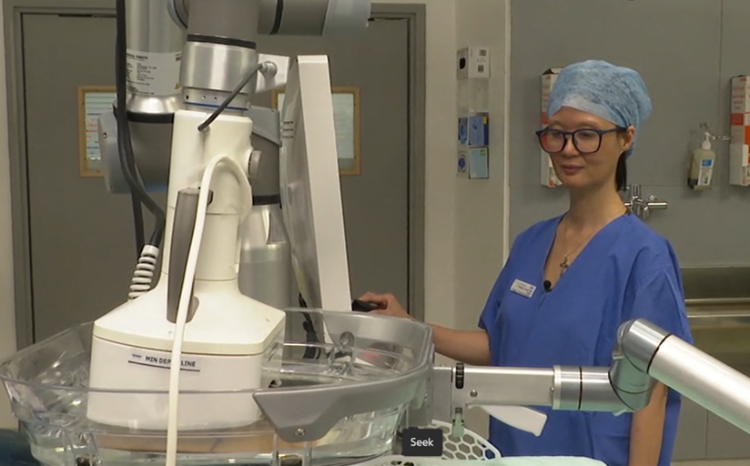
Shinkei’s computer-vision-powered robot is designed to intervene immediately. Fish are placed into a machine, which the company calls Poseidon, while still alive, and it uses computer vision AI to scan the fish to determine the fastest (and least-stressful) path forward for the fish. Once the fish is scanned, the machine performs a fast sequence: a brain spike to euthanize as quickly as possible and a gill cut (to drain blood).
If this system seems, well, rough, it is, but the reality is fish caught are experiencing high stress from the time they’re caught, and the faster the fisherman can move towards euthanization, the more humane (and ultimately fresher and better tasting the fish). Khawaja says each fish is processed in about six seconds, and the company’s goal is to get the fish into the system quickly after landing, ideally within roughly a minute, before quality begins to degrade meaningfully.
Speed on the Boat = Less Waste in the Store
While much of the pitch is focused on better taste, Shinkei’s technology also a food waste angle. According to Khawaja, their solution also helps reduce waste in the store. That’s because, typically, a suffocated fish might enter rigor mortis in about 7 hours, but Shinkei’s process expands that up to 60 hours, which creates a much larger buffer before decomposition starts. Khawaja says it also makes a difference by species, with black cod handled in a traditional way lasting four to five days, where Shinkei-handled fish can stay fresh or up to two weeks.
Khawaja attributes the compounding effect to two factors: reducing stress (less acidification) and removing blood that would otherwise diffuse through the meat and feed bacterial growth. He says the resulting shelf-life extension gives food distributors more options for logistics, allowing fish to be trucked rather than flown.
If Shinkei’s technology works as promised, one might expect to see all professional fishermen and processors installing hardware at some point, right? Maybe…not. That’s because the company’s business model is to create a branded direct-to-consumer model for its fish, so instead of selling the hardware outright, Shinkei places machines on partner boats under a zero-cost lease and retains ownership of the machines. They also require an exclusive buying structure that grants Shinkei the right to purchase the catch processed that uses its machinery.
From there, the company sells the fish into foodservice channels and retail under the brand Seremony, where they’re trying to get “Seremony grade” to catch on. Khawaja says the company has sold into top-tier restaurants globally, including Michelin 3-star destinations across multiple countries, and recently launched in Wegmans (Manhattan) and FreshDirect (New York).
Today, Khawaja says Shinkei works with eight boats, sourcing species like black cod, rockfish (including vermilion rockfish), and red snapper, plus some ad hoc species (salmon, black sea bass, and others). The boats surf water in the US west coast (Alaska down to California), Texas, and Massachusetts.”
When I asked Khawaja about the underlying technology, he told me they built their AI models in-house, collecting their own data and building a pipeline informed by work like facial recognition research (fish face, that is). The computer vision stack performs a set of inferences: identifying species, detecting key points, and generating cutting paths.
He also talked about two new projects they are working on within the platform. One is Kronos, a weight-estimation model embedded in the machine that sends catch data back to the Shinkei sales team in real time so they can start selling fish before it reaches the dock. Another is Nira, which uses sensors to predict shelf life.
“We integrate sensor data into a model, and we will be able to generate ground truth at any point in the supply chain for what shelf life and quality is for that fish,” said Khawaja.
The company recently raised $22 million and is currently at Series A. The Series A was co-led by Founders Fund and Interlagos, with new investments from Yamato Holdings, Shrug, CIV, Jaws, and Mantis.
Long-term, I wondered whether the company was open to expanding to a model in which it sells its hardware to fishermen who don’t feed their catches back to the company as part of the Seremoni pipeline. Khawaja and Shinkei completely shut the door, but for now, they’re “focused on building the brand and basically establishing and making ceremony-grade as a certification.”