





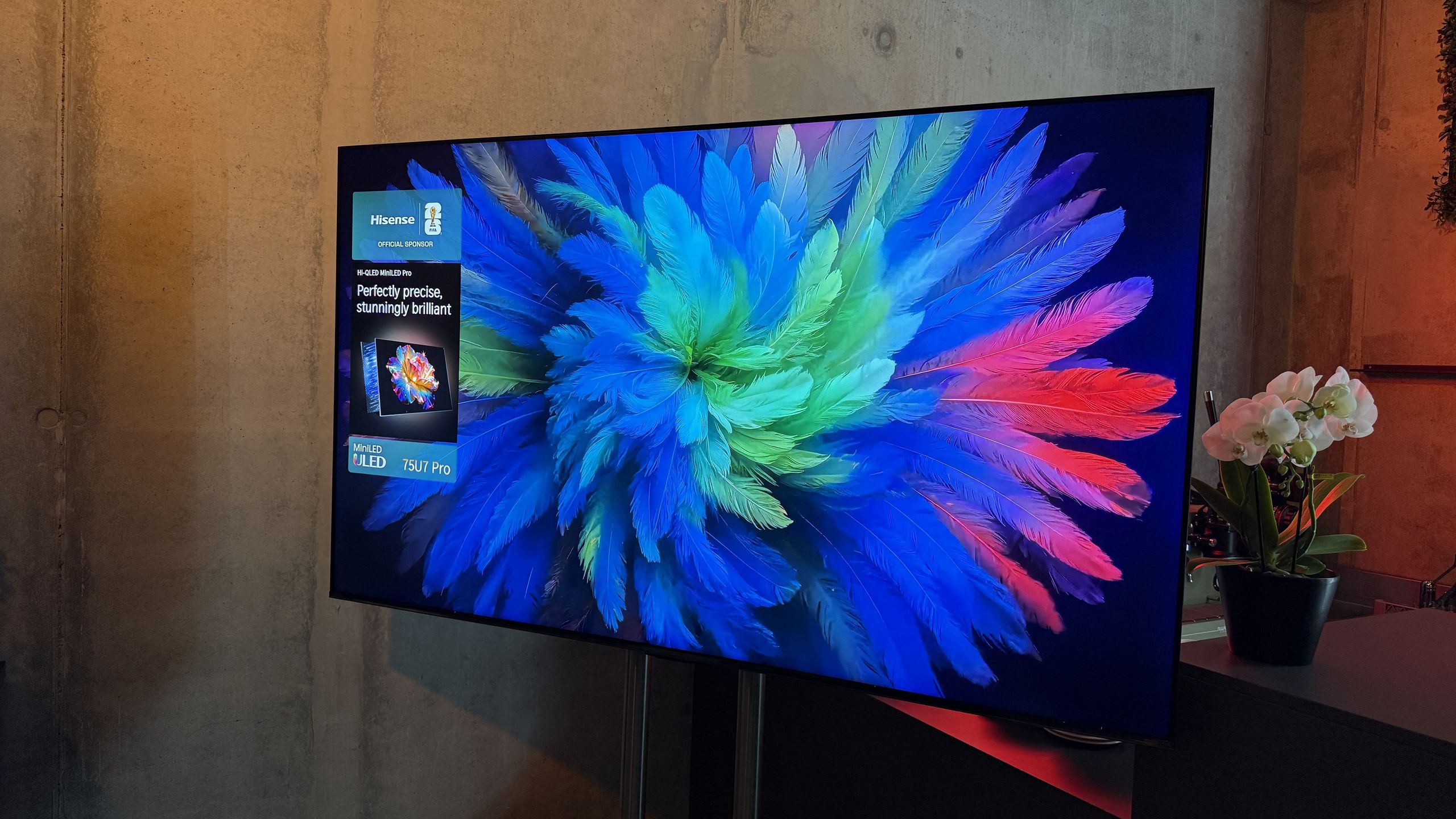



I recently got to see a lot of Hisense’s new TV range in person, including not only its higher-end RGB-backlit TVs, but also its new mid-range traditional mini-LED models.
These models — the U7 series — have hit a real sweet spot between price and image quality in larger sizes over the last couple of years, and while in most ways the new models looks like more of the same, they have one upgrade that makes them stand out over their predecessors, and it’s an area that I’m really glad to see TV companies addressing more aggressively: reflections.
in the UK there will also be two models, but one of them is more premium across the board than the other — and it’s the latter that’s equivalent to the US models for specs, and has the feature that impressed me. The cheaper model is called the Hisense U7S in the UK, and the higher-spec model that I’m mostly going to talk about is called the Hisense U7S Pro.
The key feature that’s new this year is an extra anti-reflective coating. Hisense says this is a matte layer, very much like the Glare Free finish used on the Samsung S95F or Samsung QN90F.
The idea with a matte coating is that it stops mirror-like reflections, which are the really distracting kind. Not only do they have the most detail to them, meaning they catch your eye more easily, but the reflections are on a different focal plane to the image on the screen itself, so your eye refocuses any time it catches the reflections, making them more fatiguing too.
The idea of a matte coating is to scatter light into a haze rather than reflecting it like a mirror, and this is what Samsung’s coating does. The downside is that this haze can also raise black tones and reduce the contrast, which is why it’s not been more popular in the past.
Hisense’s matte coating is much less aggressively matte than Samsung’s, though. This means it doesn’t totally haze out strong reflections — in fact, knowing it has a matte coating, I was surprised at how clear more brightly lit objects still appeared — but it does massively eliminate less-strong reflections, while still taking the edge off brighter ones.

This is in combination with really strong brightness level (a claimed 3,000 nits of peak brightness, though it’s full-screen brightness levels that affect how well something overcomes reflections, and those are always much lower. Last year’s Hisense U75QG model hit a very impressive 760-880 nits of fullscreen brightness, which is around twice as much as even the best OLED TVs can manage, making it highly effective at busting reflections on a bright image that fills the screen.
But obviously you can’t use brightness to beat reflections in parts of the screen that are supposed to be dark, and a matte layer can help.
The clearest demonstration of what this coating can do is the image below, showing three TVs. The TV on the left is a Samsung S90F OLED, the center TV is a Hisense UR9 RGB mini-LED TV with the same coating as the Hisense U7S/U7S Pro (I double-checked, and Hisense says it’s 100% the same treatment, even though it’s a higher-end TV), and the TV on the right is the LG C5 OLED.
The two OLED screens are very glossy, and have very clear reflected images; the Hisense just has some fuzzy shapes.

When I looked at the Hisense U7S/U7S Pro itself playing demo footage, I was impressed with how well it handled local dimming for strong contrast, and I did get the sense that the black tones were being aided by the matte layer.
These demo exhibitions are usually nightmares for cheap TVs because there are lights and other TVs everywhere, so any dark scenes show up the strong reflectivity they usually have — but on this model, black areas stayed deadened, in a good way.
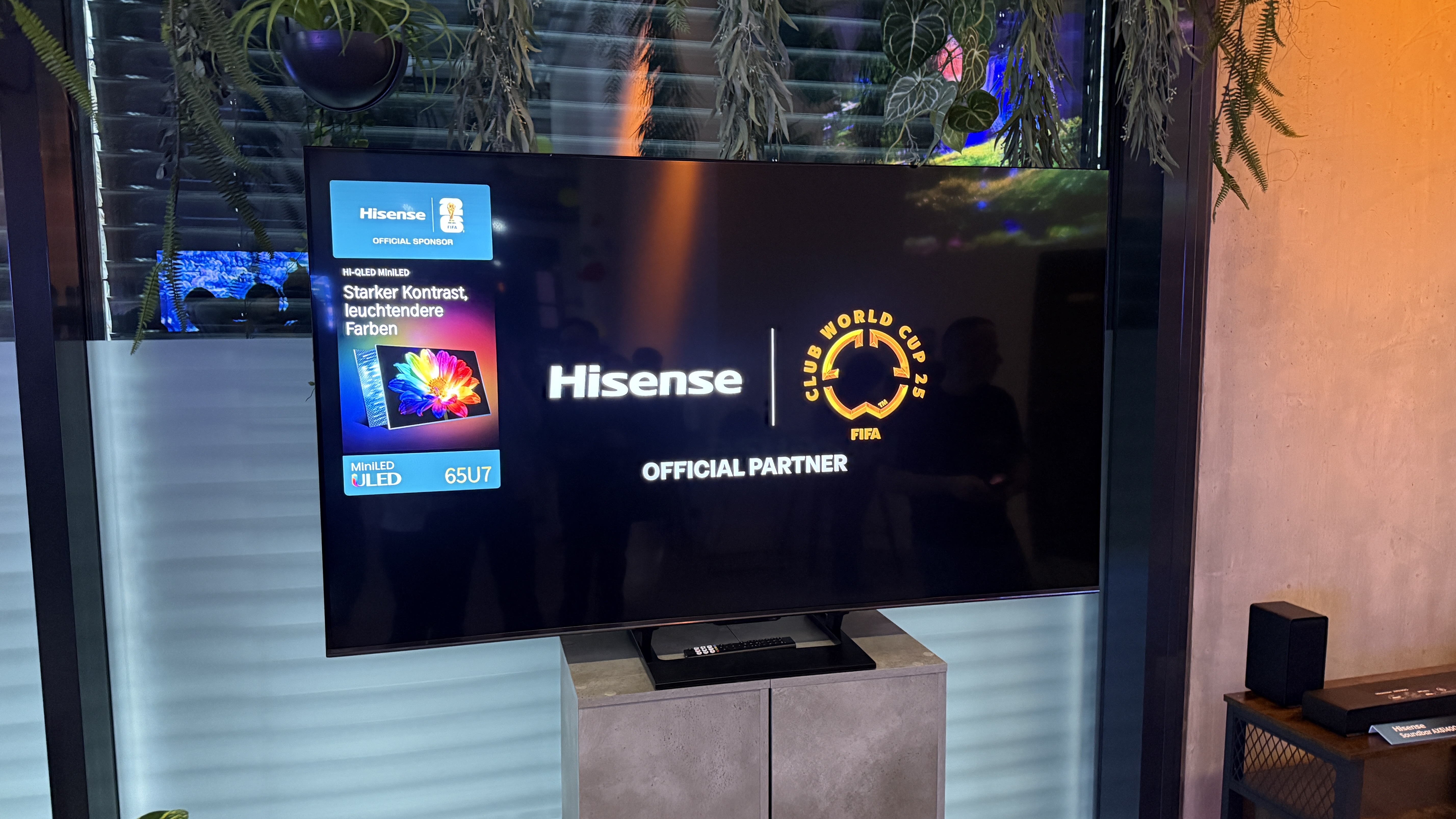
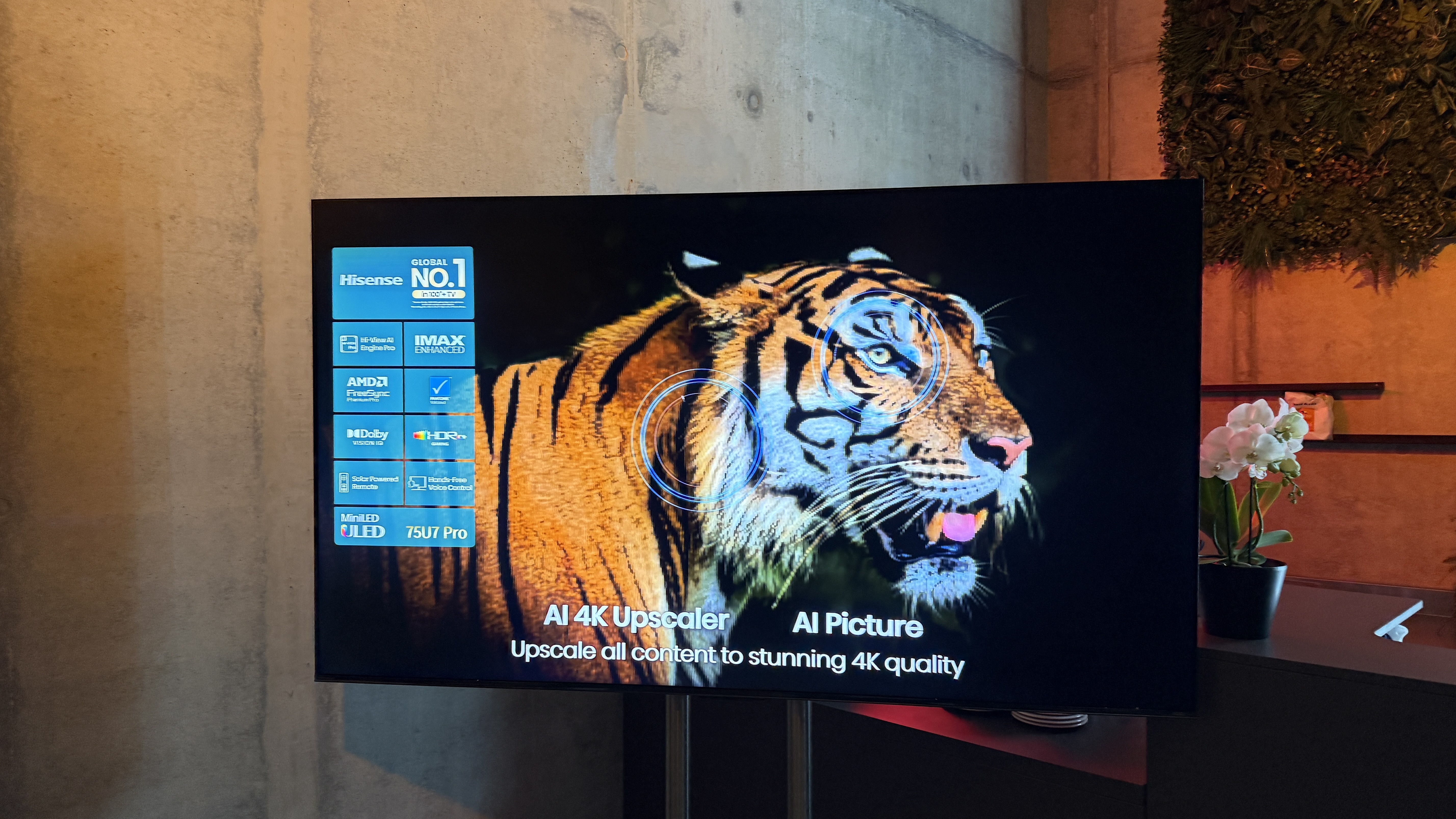
As another example, here are two photos: the first is the cheaper Hisense U7S UK model at the same exhibition with no matte screen; the second is the U7S Pro. (Sadly, they weren’t next to each other and reflecting the exact same thing, so it’s an imperfect comparison. But they were in the same space under the same lights, and I think the difference in this image is representative of what I saw in the room.)
Image 1 of 2
This all could make the U7SQ/U7S Pro the best mid-range TV for bright rooms, where sunlight and strong reflections aren’t your friend. This is commonly a problem for sports and other daytime TV viewing, or gaming during the day. (With a 165Hz refresh rate, variable refresh rate support, plus four HDMI 2.1 ports, it looks like a great gaming TV in general.)
It also looks like the clearest upgrade over the current models, which already offer great brightness and color depth, and a 144Hz refresh rate (though only two HDMI 2.1 ports).
So, should you wait for this model if you were thinking of buying a mid-range mini-LED soon? Well, it depends on how long you want to wait, because price is a huge factor here.
We don’t have prices for the UK yet, but in the US the Hisense U7SG will be initally available soon for these prices, in these sizes (100-inch and 116-inch sizes are coming later, too):
|
55-inch |
$1,299 |
|
65-inch |
$1,499 |
|
75-inch |
$1,999 |
|
85-inch |
$2,499 |
Now, you might be thinking that this doesn’t sound quite as mid-range as I promised, and I’d agree — because no one actually pays these full prices for mid-range TVs. The sets start dropping in price shortly after launch, and reach the really good prices around Black Friday, of course.
So if you were thinking of buying sooner than that — ready for the World Cup maybe — last year’s mid-range mini-LED models can be found for far, far cheaper than the new model.
For example, right now you can grab the following options from Hisense and TCL:
Today’s best Hisense mini-LED TV deals in the US & UK
So, would I recommend waiting for the new one? Well, if a TV isn’t urgent at all, I think the new Hisense might be worth waiting for. The matte screen makes it better able to handle a wide range of lighting conditions — but improvements beyond that look thin.
Still, bear in mind that we haven’t actually reviewed it yet, so the new model may have flaws we don’t know about, or be improved in ways that aren’t obvious.
Either way, you can definitely get really excellent deals on the current range, and they’re great TVs that we highly recommend.