




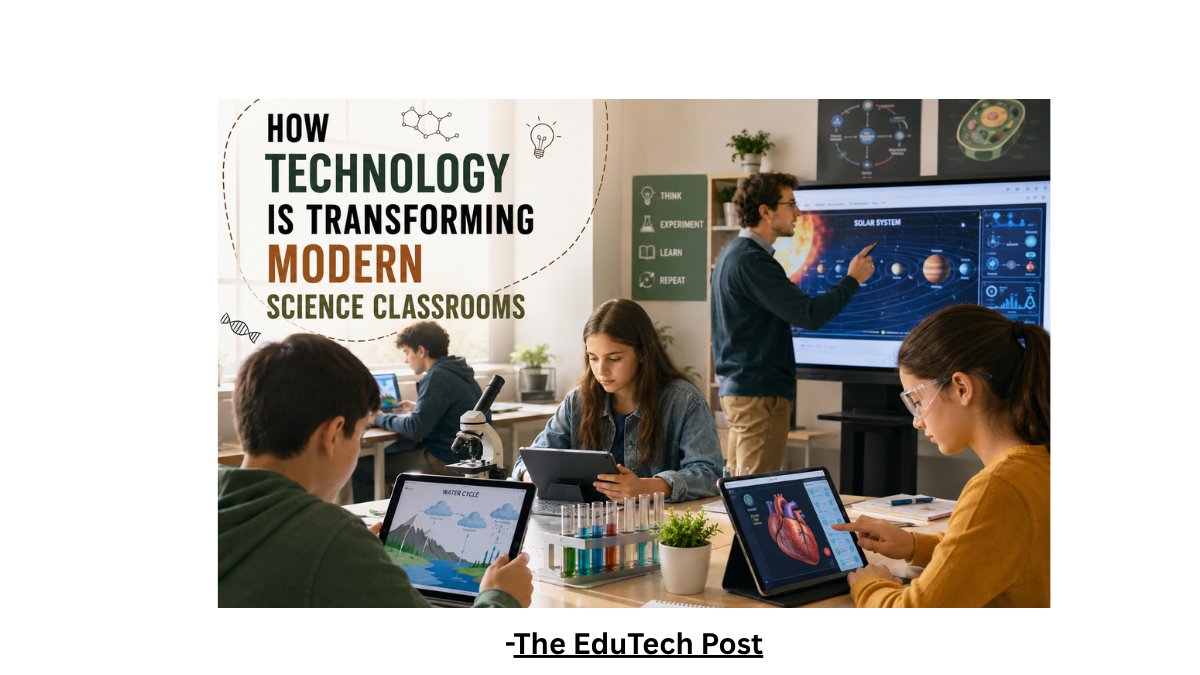

Science education has always relied on curiosity, observation, and experimentation. Traditionally, students learned scientific concepts through textbooks, classroom lectures, and laboratory experiments. While these methods are still useful, today’s classrooms are rapidly changing as digital tools influence how science is taught and comprehended.
From virtual laboratories and AI-powered tutors to interactive simulations and augmented reality (AR), technology is making science lessons more engaging, accessible, and practical. Students can now visualize complex concepts, conduct experiments in safe virtual environments, and receive personalized feedback that supports their individual learning pace.
As schools continue integrating digital tools into their teaching practices, educators are discovering new ways to inspire scientific thinking and improve learning outcomes. This transformation is not about replacing teachers but about equipping them with better resources to create meaningful and interactive learning experiences.
In this article, we’ll explore how technology is transforming modern science classrooms, the benefits it offers students and teachers, the challenges schools face, and what the future of science education may look like.
Why Technology Is Becoming Essential in Science Education
Science is a subject best understood through observation and experimentation. However, not every school has access to advanced laboratory equipment or sufficient resources to conduct every practical experiment. Technology helps bridge this gap by bringing scientific concepts to life through digital experiences.
Interactive learning platforms allow students to explore the human body in three dimensions, observe planetary movements, simulate chemical reactions, or analyze microscopic organisms—all without leaving the classroom. These digital experiences improve conceptual understanding and encourage students to ask deeper scientific questions.
Technology also makes science education more inclusive by providing accessible learning materials for students with different learning needs. Visual learners, auditory learners, and students requiring additional support can all benefit from multimedia content tailored to their preferences.
Virtual Laboratories Are Expanding Learning Opportunities
One of the biggest innovations in modern science classrooms is the use of virtual laboratories.
Virtual labs allow students to perform experiments using computer simulations instead of physical equipment. While they don’t replace hands-on laboratory experiences entirely, they provide valuable opportunities when resources, safety concerns, or time limitations make traditional experiments difficult.
Students can safely perform chemistry experiments, explore biological systems, or study physics concepts without worrying about hazardous materials or expensive equipment.
Some key advantages include:
- Safe experimentation without risk
- Unlimited practice opportunities
- Reduced laboratory costs
- Equal access for remote learners
- Instant feedback on experimental procedures
Virtual laboratories also encourage students to experiment freely. Mistakes become learning opportunities rather than costly errors.
🎥 Watch: How Virtual Labs Are Revolutionizing Science Education
Want to see virtual laboratories in action? This TED Talk by Michael Bodekaer demonstrates how digital lab technology is making science education more accessible, interactive, and engaging for students worldwide.
Artificial Intelligence Is Personalizing Science Learning
Artificial Intelligence (AI) is changing the way students interact with educational content. Instead of delivering identical lessons to every student, AI-powered learning platforms analyze individual progress and recommend personalized learning paths. Students struggling with specific science topics receive additional explanations, quizzes, or practice activities until they demonstrate mastery.
Teachers also benefit from AI by receiving insights into student performance. Learning analytics help identify misconceptions early, allowing educators to provide targeted support before small gaps become larger learning challenges.
AI-powered assessment tools can automate routine grading while providing immediate feedback, giving teachers more time to focus on instruction and student engagement.
Rather than replacing educators, AI acts as an intelligent teaching assistant that enhances classroom efficiency.
Interactive Simulations Make Complex Concepts Easier to Understand
Many scientific concepts are difficult to visualize using static textbook diagrams alone. Students can manipulate variables and see real-time results with interactive simulations. Instead of simply reading about Newton’s Laws or DNA replication, learners can explore these concepts through engaging digital models.
For example:
- Students can adjust gravity and observe changes in planetary motion.
- Physics learners can experiment with forces and acceleration.
- Biology students can simulate cell division step by step.
- Environmental science classes can model climate change scenarios.
These visual experiences help students connect theory with real-world applications, improving both understanding and long-term retention.
Augmented and Virtual Reality Create Immersive Learning Experiences
Augmented Reality (AR) and Virtual Reality (VR) are transforming science education into an immersive experience.
With AR applications, students can point a tablet or smartphone at a textbook image and instantly view a rotating 3D model of the human heart, a molecule, or the solar system.
VR goes even further by placing students inside virtual environments where they can:
- Explore the surface of Mars
- Walk through a human bloodstream
- Visit ancient ecosystems
- Conduct dangerous experiments safely
- Observe geological formations up close
These immersive experiences make abstract scientific concepts easier to understand while significantly increasing student engagement. Research consistently suggests that students remember information better when they actively participate in learning rather than passively consuming content.
Real-Time Data Collection Is Strengthening Scientific Inquiry
Modern science classrooms increasingly use digital sensors and smart devices to collect real-time experimental data.
Students can measure:
- Temperature
- Air quality
- Light intensity
- Motion
- Heart rate
- Sound levels
Instead of manually recording observations, digital tools generate accurate graphs and visualizations instantly. This allows students to spend less time on calculations and more time interpreting results, identifying patterns, and developing scientific reasoning skills.
Real-time data collection also introduces students to the technologies used by professional scientists, preparing them for future careers in research, engineering, healthcare, and environmental science.
Cloud-Based Learning Is Encouraging Scientific Collaboration
Science has always been a collaborative field, and modern classroom technology is making teamwork easier than ever. Cloud-based platforms enable students to work together on projects, share research findings, and receive teacher feedback in real time, whether they are in the classroom or learning remotely.
Students can collaborate on lab reports, analyze shared datasets, and build presentations using online tools. Teachers can monitor progress, leave comments, and guide discussions without waiting until the next class.
This collaborative approach mirrors how scientists work in the real world. Researchers across different countries regularly share data and ideas through digital platforms, and today’s students are developing similar teamwork and communication skills that will benefit them in higher education and future careers.
Gamification Is Making Science More Engaging
Keeping students motivated can be challenging, especially when scientific concepts become complex. Technology is helping address this challenge through gamification.
Gamification applies game-like elements—such as quizzes, badges, leaderboards, and achievement levels—to educational activities. Instead of memorizing facts from a textbook, students participate in interactive challenges that reward progress and encourage problem-solving.
Educational science games can help learners:
- Strengthen critical thinking skills.
- Practice scientific reasoning through simulations.
- Improve knowledge retention.
- Increase classroom participation.
- Build confidence by learning from mistakes.
When utilized correctly, gamification transforms science classes into fun learning experiences that keep educational goals at the forefront.
Technology Is Preparing Students for Future STEM Careers
Today’s students will enter a workforce where scientific knowledge and digital literacy are closely connected. Careers in healthcare, biotechnology, environmental science, engineering, robotics, and artificial intelligence increasingly require both scientific understanding and technological skills.
Modern science classrooms introduce students to tools they may encounter in these professions, including data analysis software, coding platforms, digital microscopes, simulation programs, and collaborative online workspaces.
By integrating technology into everyday learning, schools are helping students develop:
- Digital literacy
- Data interpretation skills
- Computational thinking
- Scientific problem-solving
- Collaboration and communication skills
- Adaptability to emerging technologies
These competencies are becoming just as important as traditional scientific knowledge in today’s innovation-driven economy.
Challenges of Integrating Technology into Science Classrooms
While technology offers tremendous opportunities, successful implementation is not without challenges.
One major concern is unequal access to digital devices and reliable internet connections. Schools in underserved communities may struggle to provide students with the same technological resources available elsewhere, creating gaps in learning opportunities.
Teacher training is another important factor. Even the most advanced educational tools have limited impact if educators are not confident using them effectively. Continuous professional development ensures teachers can integrate technology in ways that genuinely improve learning rather than simply replacing traditional teaching methods.
Schools must also balance screen time with hands-on experiments. Practical laboratory experiences remain essential for developing observation skills, scientific inquiry, and teamwork. Technology should complement—not replace—real-world experimentation whenever possible.
Finally, student data privacy and cybersecurity have become increasingly important. Schools must adopt secure digital platforms and educate both teachers and students about responsible online practices.
The Future of Technology in Science Education
The future of science education will likely become even more interactive, personalized, and data-driven.
Artificial intelligence will continue supporting personalized learning pathways, while augmented and virtual reality may become common classroom tools as costs decrease. Emerging technologies such as digital twins, advanced scientific simulations, and adaptive assessment systems could further transform how students explore scientific concepts.
At the same time, educators will remain at the heart of the learning process. Technology can enhance instruction, automate routine tasks, and provide richer learning experiences, but it cannot replace the guidance, encouragement, and critical thinking that skilled teachers bring to the classroom.
The most successful science classrooms will combine innovative technology with effective teaching practices to foster curiosity, creativity, and lifelong learning.
Final thoughts
Technology is fundamentally changing how students experience science education. From virtual laboratories and AI-powered learning platforms to immersive AR and VR experiences, digital innovations are making science more engaging, accessible, and relevant than ever before.
However, technology alone is not the solution. Its true value lies in how teachers integrate it to encourage inquiry, collaboration, and critical thinking. When combined with hands-on experimentation and strong instructional practices, technology helps students move beyond memorizing facts to developing a deeper understanding of how science shapes the world around them.
As schools continue embracing digital transformation, modern science classrooms will prepare learners not only to succeed academically but also to become the next generation of scientists, engineers, innovators, and informed global citizens.
Frequently Asked Questions (FAQs)
How is technology transforming modern science classrooms?
Technology is transforming modern science classrooms through AI-powered learning, virtual laboratories, interactive simulations, augmented reality, and smart classroom tools. These technologies make scientific concepts easier to understand while improving student engagement and collaboration.
What are the biggest benefits of using technology in science education?
Technology enhances visualization of complex concepts, encourages personalized learning, supports collaboration, provides access to virtual experiments, and prepares students for future STEM careers.
Can technology replace traditional science laboratories?
No. Technology complements traditional laboratories rather than replacing them. Virtual labs help students practice experiments safely, but hands-on laboratory work remains essential for developing practical scientific skills.
How does AI improve science learning?
Artificial intelligence analyzes student progress, identifies learning gaps, recommends personalized study materials, and provides instant feedback, allowing teachers to focus more on instruction and individual support.
What does the future of technology in science classrooms look like?
The future includes greater use of AI, virtual reality, augmented reality, adaptive learning platforms, smart laboratories, and data-driven teaching methods that make science education more engaging and effective.
Also Read: How AI Homework Helpers Are Transforming Education in 2026