









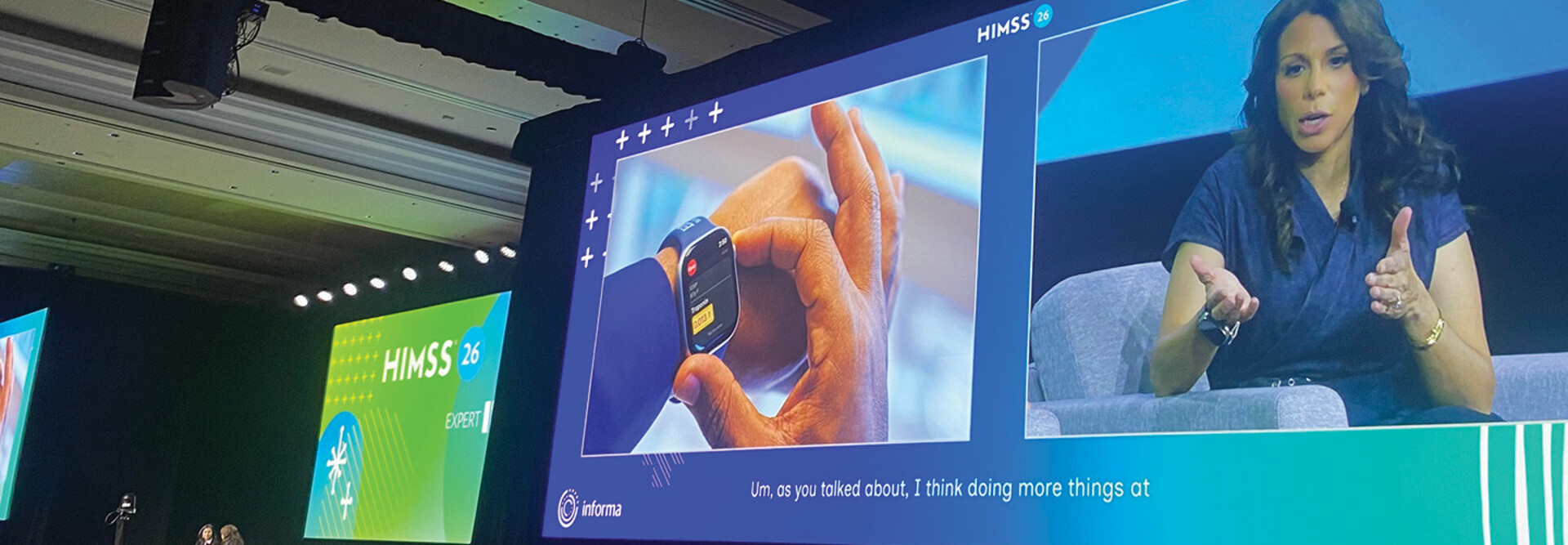
“You should never leverage technology for technology’s sake. It has to solve a problem,” Dr. Sumbul Ahmad Desai, vice president for health and fitness at Apple, said during her keynote conversation Wednesday with Dr. Ami Bhatt, chief innovation officer at the American College of Cardiology. “I find that if there’s a cool technology, people are like, ‘What can I do with this in health?’ Or, ‘I can do this in the consumer space; can it apply in the healthcare world?’ And a lot of times, that’s not the case. Operations people have to be involved in all of these conversations, and they’re integral to how healthcare runs its business. And how technology can be used has to be woven into that. Same thing with the clinical model: It has to be rolled into the clinical pathway. So, we really need to get into the details.”
Focusing on those details is crucial for healthcare organizations to create new experiences and to innovate with intention, Desai added.
Improving Experiences for the Care Continuum
Desai began her career in journalism. But after becoming a caregiver following her mother’s stroke in 2001, she fell “in love with medicine — the multidisciplinary nature. When everything works, it’s like an orchestra coming together.”
She went to medical school and did her residency at Stanford during the early years of its Epic deployment, which was how she also developed an interest in technological implementation. “I’m always someone who likes to understand how things work, building things, and I got to see that from the ground up,” she said.
Since joining Apple in 2017, she has overseen the development of wearables to become more clinically relevant. In 2018, Apple released an electrocardiogram app for the Apple Watch Series 4 meant to help find irregularities in heart rhythm related to atrial fibrillation.
READ MORE: How to strengthen the muscle of AI strategy with clinical insight.
“We don’t want to just empower you. We want to empower you to have a better relationship with your healthcare provider,” Desai said. “For all of our features, we actually design a physician report meant for physicians. It’s designed by physicians, for physicians.”
Regarding the future of the industry, she said she hopes that “seamless, actionable insights” can be connected throughout a care continuum for better patient and provider experiences.
“We really want to deliver streamlined workflows and clinically validated ways to use technology,” Desai said. “But again, it’s not just about the technology. It really has to be the model that is around the technology.”
Click the banner below to keep up with key healthcare IT insights after HIMSS 2026.