







By Manuel Nau, Lead Editor at IoT Business News.
Gartner’s strategic predictions for 2027 and beyond point to a growing convergence between artificial intelligence and physical infrastructure, with autonomous agents, robots, energy systems and runtime governance becoming increasingly interconnected.
The next phase of enterprise AI is likely to be measured less by what models can generate and more by what they are allowed to do. As AI systems gain access to machines, vehicles, energy infrastructure and connected operational environments, questions of identity, control, cost and accountability move from the application layer into the IoT architecture itself.
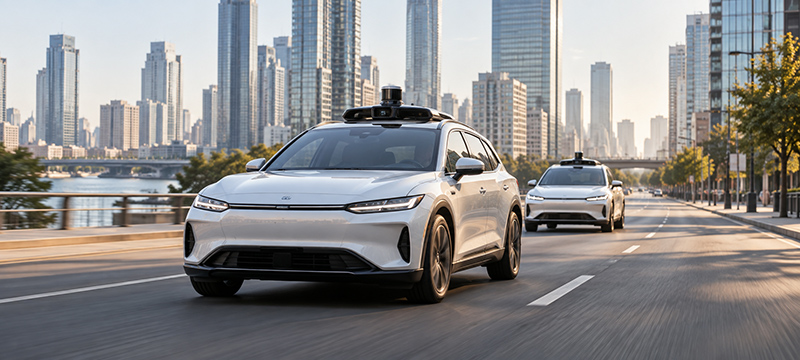
That shift is visible across Gartner’s latest strategic predictions. The research firm expects that by 2030, 80% of front-line workers employed by international companies will be assisted by physical AI systems, including robots, drones and autonomous vehicles. Gartner also forecasts more than 10 billion autonomous agents created by individuals, businesses and governments by the end of the decade.
Physical AI turns IoT infrastructure into an execution environment
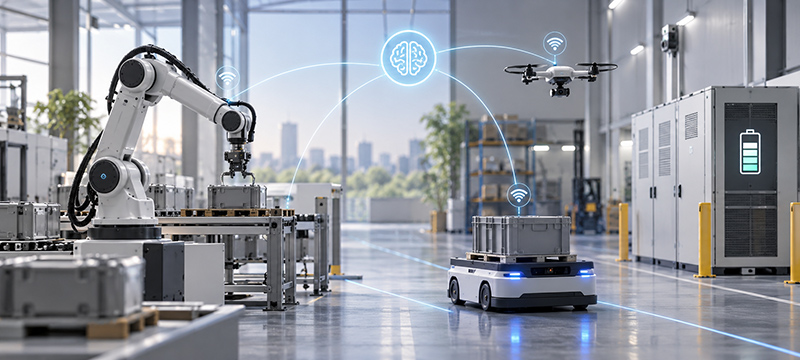
For IoT professionals, the physical AI prediction is particularly significant because these systems depend on much more than AI models. Robots and autonomous equipment require sensors, connectivity, local computing, device identity and interfaces capable of turning software decisions into physical actions.
This changes the role of connected infrastructure. Traditional IoT architectures primarily collect telemetry and expose devices to applications. Physical AI adds another requirement: the infrastructure must safely support software that can interpret conditions and initiate actions.
That evolution is already becoming visible at the technology level. Recent developments are exploring how AI agents could operate as a control layer for connected equipment, while increasingly compact models are bringing agentic capabilities closer to edge devices.
The practical implication is that IoT platforms may increasingly need to manage not only devices and users, but machine-generated actors. An autonomous agent requesting sensor data, changing an operating parameter or instructing a robot potentially needs its own identity, permissions and audit trail.
Governance moves into runtime infrastructure
Several of Gartner’s predictions reinforce that point. The firm expects insurers to become an important force shaping AI governance by 2030, as liability underwriting pushes organizations toward stronger technical controls. Gartner also predicts that 80% of Global 500 companies will contractually designate their CIO or CAIO as an “Evidence Custodian” responsible for AI accountability.
For industrial IoT deployments, that could make traceability a system-level requirement. It may no longer be sufficient to record that a device changed state. Enterprises could also need evidence showing which AI system requested the action, what information influenced it, which controls approved it and what happened afterwards.
This is an important distinction from many current AI governance initiatives, which concentrate on models, prompts and data. Once AI interacts with physical assets, governance extends down the stack toward device management, access control, telemetry and operational technology.
Energy management becomes another IoT-AI intersection
Gartner also expects rising AI electricity demand to change the role of large enterprises. By 2030, it predicts that Global 2000 companies will collectively own $10 trillion in energy assets and increasingly sell power to grids and AI data centers. The firm points to generation, storage and energy management becoming strategic enterprise capabilities.
This has a direct IoT dimension. Distributed generation, batteries, building systems and industrial loads only become flexible energy resources when they can be monitored and coordinated. Energy management therefore becomes another area where connected assets, operational data and automated decision-making converge.
A broader architecture change for IoT
What makes Gartner’s predictions relevant to the IoT sector is not any single forecast, but the architecture emerging when they are considered together. AI agents are multiplying, physical AI is interacting with machines, enterprises are managing energy dynamically, and governance is moving toward continuous runtime oversight.
For OEMs and system integrators, this increases the importance of exposing device capabilities through controlled software interfaces rather than simply delivering connectivity. Connectivity providers may increasingly need to support identity, policy enforcement and reliable communications for autonomous systems whose traffic and actions are initiated by software rather than humans. Industrial operators, meanwhile, will need clearer boundaries between AI-generated decisions and deterministic safety controls.
The underlying change is subtle but consequential: IoT infrastructure is evolving from a mechanism for observing the physical world into an execution layer for AI-driven operations. Gartner’s predictions suggest that managing who — or increasingly what — is allowed to act through that infrastructure may become as important as connecting the assets themselves.