







Why you can trust TechRadar
We spend hours testing every product or service we review, so you can be sure you’re buying the best. Find out more about how we test.
FiiO M27: Two-minute review
If there’s a stone FiiO has left unturned in the way it’s specified and built the M27 digital audio player, it’s invisible.
So if you want a player (a big and heavy player, let’s be honest) with enough power to drive even the trickiest of headphones, with battery life that’s approaching ‘epic’, and that arrives with its own little desktop charging stand with integrated cooling fan, you’ve come to the right place.
All of this would count for very little, though, if the FiiO M27 didn’t have it where it really counts. Happily, this is a great-sounding machine – or, at least, it is if you treat it respectfully. Hi-res stuff enjoys amazing detail resolution, expansive soundstaging, sky-high dynamic response and the sort of singularity of presentation that makes every listen an event. Lower-resolution stuff, though, is basically exposed to ridicule. So don’t imagine the M27 is about to flatter your choices if your choices are incorrect…
Among the best MP3 players on the market then? Oh, without a doubt.

FiiO M27 review: Price and release date
- Released November 2025
- Priced $1,799 / £1,499 / AU$2,699
The FiiO M27 launched in the middle of November 2025, and in the United Kingdom it’s priced at £1,499. In the United States it sells for $1,799, while in Australia you’re looking at AU$2,699.
And just because it’s possible to pay plenty more than this for a premium digital audio player, that doesn’t mean the M27 hangs out anywhere near the ‘affordable’ category…

FiiO M27 review: Features
- Twin ESS Sabre ES9039S PRO DAC chipsets
- Bluetooth 5.4 with aptX Lossless, Bluetooth LE Audio and Auracast support
- 9200mAh battery
FiiO never knowingly underspecifies its products – so when it’s going all-out to create a class-leading, market-defining digital audio player, it follows that the feature-count here is significant.
For the M27, FiiO has leaned heavily on Qualcomm’s expertise. The machine features the company’s QCS6490 chipset with Snapdragon 770G architecture. Along with eight (count ‘em!) Kryo 670 cores and an Adrena 642L GPU, this arrangement promises lightning-fast response times, effortless multitasking and a solid foundation for streaming and playback no matter the size or type of the digital audio file the player is dealing with.
Qualcomm’s QCC5181 chipset makes an appearance too. It facilitates Bluetooth 5.4 wireless connectivity when the M27 is acting as a receiver, and allows for aptX Lossless and LDAC codec compatibility as well as Auracast and Bluetooth LE Audio. The FiiO will also function as a Bluetooth transmitter – in this direction it’s running Bluetooth 5.2 with support for aptX Adaptive and LDAC.
There’s more. Qualcomm’s Dragonwing AI platform, allows the M27 to offer a 31-band PEQ at resolutions up to 32bit/384kHz (among other things), global ‘All to DSD’ functionality for bitrates from DSD64 to DSD256, and fully controllable end-to-end audio processing.
The crucial business of digital-to-analogue conversion is taken care of by a couple of ESS Sabre ES9039 PRO chipsets that are good to go with resolutions of up to 32bit/768kHz PCM and DSD512. They’re supported by sixth (and latest) generation of FiiO’s ‘Digital Audio Purification System’, which deploys a new FPGA and dual RIVER femtosecond crystal oscillators in a drive for vanishingly low jitter and optimal timing accuracy.
The M27 features a replaceable 9200mAh battery, which is a) good news where product longevity is concerned, and b) a massive amount of power. It translates to eight hours of playback via a balanced output or a touch over nine from an unbalanced alternative – and it also allows for power outputs big enough to drive even the most truculent headphones. And on the subject of big power outputs, if you connect the M27 to mains power via a fast charger and select ‘Ultra High Gain’ mode, a giddy 10,000mW of power is available.
Naturally the list goes on (and on). The M27 features a six-stage fully differential audio circuit – it doubles up on the high-quality components like signal relays, volume control chips and TI op-amps in order to independently process each channel of audio information, and then drives them via discrete power supplies. It has a high-current, low-loss, MOSFET-managed power path with big energy storage capacitors; it has copper heatsinks; it has a graphite vapour chamber and graphene thermal conduction pads integrated into the chassis to enable effective cooling.
And it has more besides. But for the sake of brevity, it’s probably enough to know that FiiO has left nothing – by which I mean nothing – to chance where the specification of the M27 is concerned.
Features score: 5 / 5

FiiO M27 review: Sound quality
- Remarkably complete and articulate rendition of hi-res audio files
- Deeply impressive powers of resolution and organisation
- Almost comically intolerant of lower resolution stuff
I’m guessing that anyone who’s thinking of dropping this sort of money on a digital audio player is well served for properly high-resolution digital audio content. I certainly hope so – because while the way the M27 handles hi-res stuff is thoroughly enjoyable and deeply impressive, it’s got next-to-no time for stuff that dips below the magic 16bit/44.1kHz point.
So while a 24bit/192kHz file of David Bowie’s Low (which has somehow just had its 50th birthday) is delivered in the most eloquent, revealing and utterly engaging manner, the same content streamed as a 320kbps file via Spotify sounds almost as if the M27 is taking it personally.
Big files are lavishly detailed, arranged on a large and convincingly defined soundstage, and are laid out with considerable ‘left/right’ distance available and quite a lot of ‘front/back’ too. The spaces between elements of the recording are carefully observed, and even if the music involves few participants on this very big stage there’s a tangible sense of ‘togetherness’ about the way the FiiO presents it. The unity of its delivery makes for a confident and believable overall performance.

It’s possible to fiddle with the sonic characteristics of the M27 quite extensively, of course – but leave well enough alone and the player has a neutral, uncoloured tonality that makes for a naturalistic presentation. The attention to detail it exhibits means texture and timbre of instruments and of voices are made apparent, and the low-level dynamic variations or harmonic under- and overtones are made apparent every time.
Frequency response, too, is convincing – from the deep, hard-hitting and endless varied bottom end to the bright, attacking top, the FiiO gives every area fair weighting and representation. And in the midrange, it communicates in the most direct and unequivocal manner – if there’s even a transient, minor detail concerning tone, technique, attitude or character in a voice, you can be sure the M27 is handing it over.
Those low frequencies are beautifully shaped and their attack and decay is observed in the hawk-like manner. As a result, rhythmic expression is almost casually correct and momentum levels are always appropriate to the material. Add in apparently limitless dynamic headroom and the full account of big shifts in volume or intensity that results, and the M27 goes quite a distance towards the accolade of ‘best pound-for-pound digital audio player on the market’ it craves.
Lower the tone, though, and cue up some lower-resolution content and the FiiO can’t really disguise its disdain. It’s a bit like watching Lewis Hamilton drive a bog-standard hatchback around a racing track: he’ll wring the maximum out of it, but at the same time he’s got one hand on the wheel, he’s checking his look in the rear-view mirror… it’s too easy.
Give the M27 a stream from Spotify’s free tier and it quite ruthlessly exposes the compression and its knock-on effects where dynamics, detail levels, harmonic accuracy and all the rest of it are concerned. You might be thinking ‘Well, it would, no?’ but honestly some players try to make the best of this sort of content. The FiiO M27 is simply not one of those players.
Sound quality score: 4.5 / 5

FiiO M27 review: Design
- Titanium or aluminium alloy chassis
- 157 x 85 x 28mm (HxWxD)
- 6in 1080p touchscreen
Until you see and hold it, the fact the M27 measures 157 x 85 x 28mm (HxWxD) and weighs somewhere between 550g and 630g (depending on your choice of chassis material – aluminium alloy or titanium are available) might seem a little abstract.
And then you see it and hold it, and you realise the FiiO is not ‘portable’ in the way lots of less expensive digital audio players are ‘portable’. This is a hefty unit, and the shirt pocket that’s strong enough to accommodate it has yet to be invented. Think of it in terms of ‘small desktop device’ rather than ‘pocket-friendly go-anywhere player’ and you won’t be far wrong.
Mind you, FiiO has gone to considerable lengths to make sure the look and feel also says ‘premium’ as much as it says ‘chunky’. The industrial design is interesting – angular and pointy but not threateningly so – and the choice of metals for the chassis (titanium or aluminium alloy) is a nice touch too. The front of the M27 is basically all Gorilla Glass-covered 6in 1080p touchscreen display, and the rear panel is a marble-effect slice of glass fibre. FiiO supplies a snug-fitting real leather case to help keep your M27 in tip-top condition. No mention is made of a vegetarian option.
Build quality is unarguable – the FiiO feels solid and made to last. The asking price insists on a certain standard of finish, of course, and it’s a standard the M27 comfortably surpasses.
Design score: 5 / 5

FiiO M27 review: Usability and setup
- Android 13 OS
- Six functionality modes
- Fan-assisted charging stand
Accessing the full and exhaustive list of functions and options available to the M27 user can be done via the touchscreen. The FiiO is running an almost complete version of Android 13 as on operating system, and it’s just as swift and responsive to use as the prodigious processing power promises.
There are also a selection of physical controls, though, along with a comprehensive suite of inputs and outputs. On the upper edge of the chassis there’s a big turn/press dial dealing with power on/off and volume control. There are three analogue outputs/headphone sockets up here, too: 3.5mm and 6.3mm balanced connections with a 4.4mm balanced alternative inbetween. On the bottom there’s space for a full-size Toslink digital optical output, a coaxial on an RCA socket (it can function as either an in- or an output), two microSD card slots (each of which can accept cards of up to 2TB capacity), a ’hold’ switch to disable all physical and touch-controls, a switch to turn ‘desktop mode’ on or off, and three USB-C slots. One is for either charging the battery, or powering the M27 from the mains. One is for charging and also for data transfer. The third, which is designated ‘USB HOST’, allows connection to an external DAC if you wish to use your player as a digital transport.
‘Desktop mode’, by the way, bypasses the battery entirely when the M27 is connected to mains power, which obviously has benefits for the life of the battery. The other functionality modes are ‘Android’ (which allows access to third-party streaming apps), ‘Pure Music’ (only the FiiO Music app is available), ‘USB DAC’ (so the player can act as a soundcard for external devices), ‘AirPlay’ (no explanation necessary) ,‘Bluetooth Receiving’ (which turns the M27 into a Bluetooth amplifier), and ‘Coaxial Decoding’ (which allows digital information incoming via the coaxial socket to access the FiiO’s D-to-A circuitry). Something for everyone, I think we can agree.
On the left side of the player you’ll find a few physical control buttons: skip forwards, skip backwards, play/pause and a user-definable ‘multifunction’ control. On the right there’s a fairly large patch behind which the FiiO stores its wireless antennae. And on both sides there’s an area for some completely gratuitous lighting effects.
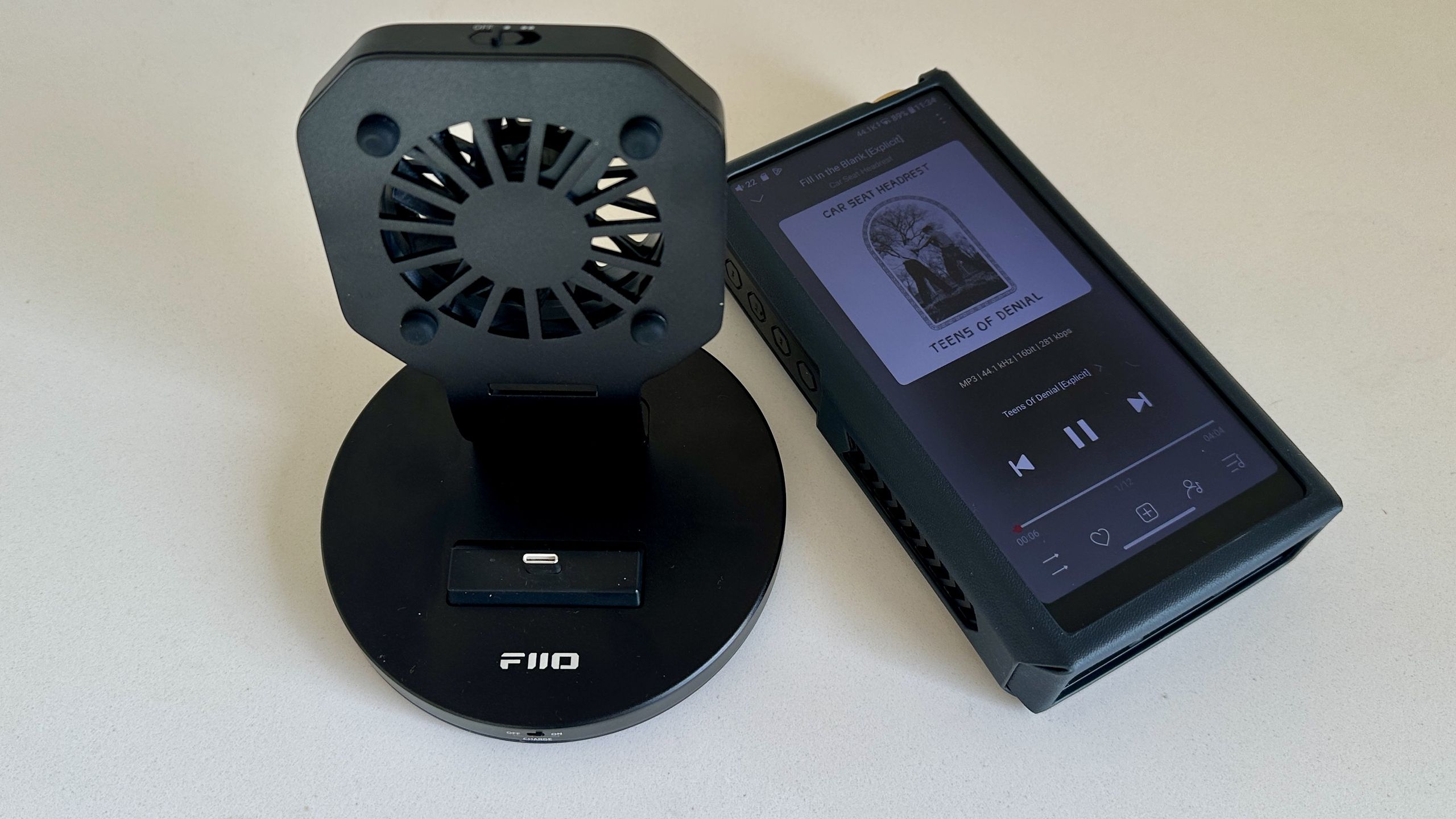
The M27 is supplied with a neat desktop charging stand with its own line-up of USB-C connections as well as an integrated fan to keep the M27 cool. The protective leather case features a stainless steel hollow-cut panel on its rear, backed by a gel pack, in a further effort to make sure the player runs cool.
Usability and setup score: 5 / 5

FiiO M27 review: Value
Fundamentally, the M27 doesn’t do anything that a less affordable digital audio player (not least from the FiiO catalogue) can’t do. But that’s slightly besides the point: the M27 is not only a fine-sounding player with a stack of wider functionality where desktop and full-system use are concerned, but it’s a quite luxurious accessory in the manner of some nice jewellery or a handmade pair of shoes.
If you’re a hard-nosed, clear-eyed consumer than you’ll struggle to make a case for the M27 – but if you value the intangibles as much as, well, the tangibles, there’s an awful lot to like (and to covet, quite frankly) about this FiiO machine.
Value score: 5 / 5

Should I buy the FiiO M27?
Buy it if…
Don’t buy it if…

FiiO M27 review: Also consider

How I tested the FiiO M27
I downloaded Qobuz and Tidal streaming service apps from the Google Play store, and slotted a 512GB SanDisk microSD card (filled with hi-res audio content) into one of the two microSD card slots.
I connected the player to wired and wireless headphones of appropriate quality (the Sennheiser IE900 on a 4.4mm balanced connection proved particularly sympathetic), and I also used it as a desktop DAC. And then I listened to lots of different types of music, stored in many different formats and at a variety of resolutions.
- First reviewed in January 2026