











When it comes to systems for cleaning up marine oil spills, most of them simply float in place, waiting for the oil to come to them. A new robot, however, could proactively move through oil slicks – and it’s inspired by both a dolphin and a sea urchin.
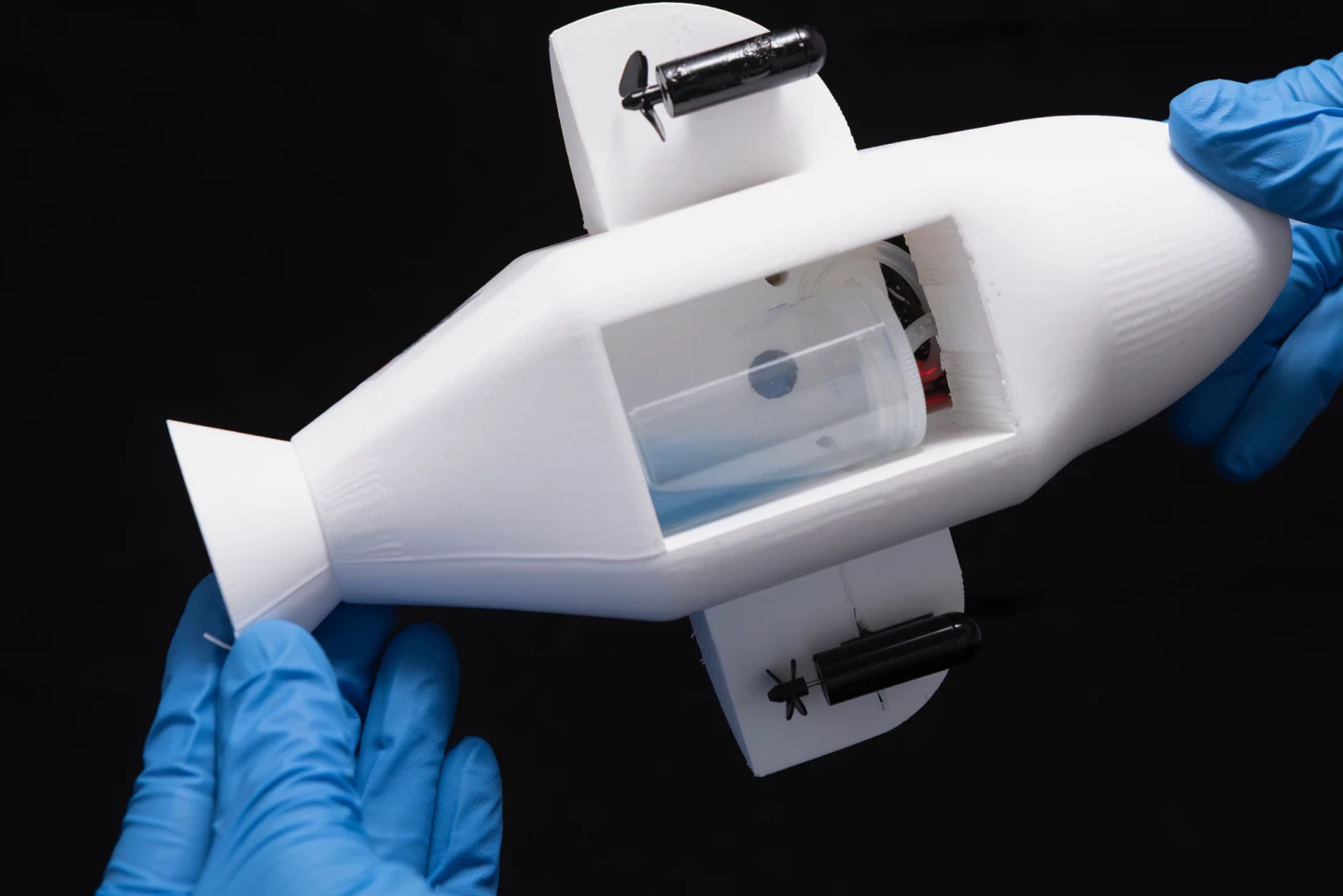
Known as the Electronic Dolphin, the experimental device is being developed by scientists at Australia’s RMIT University. Designed to move across the surface of the water, it’s about the size of a sneaker in its current small-scale form, and it utilizes a unique filtering system inspired by the one used by sea urchins.

Peter Clarke, RMIT University
As the Electronic Dolphin moves through an oil slick, an onboard pump draws the oily water into the filter, which is essentially a sponge with a “special coating” of microscopic spikes (namely oleic acid-functionalized barium carbonate with reduced graphene oxide nanosheets). Those spikes hold tiny pockets of air that cause water to roll off the filter, while still allowing oil to stick to it.
As a result, the filter absorbs only oil, without becoming saturated with water. And once the material is full of oil, it can be discharged and reused multiple times. The discharged oil is stored in an onboard chamber.
Peter Clarke, RMIT University
In lab trials performed so far, the Wi-Fi-controlled robot was able to recover oil from water at a rate of about 2 milliliters per minute with more than 95% purity, running for approximately 15 minutes per battery-charge. Plans call for the final product to be scaled up considerably, however.
“We envision the robot to be approximately the size of a dolphin,” lead scientist Dr. Ataur Rahman tells us. “The final dimensions will depend on the capacity of the pump and the onboard container used to store the recovered oil.”
“It will operate as a fully autonomous, standalone system. The robot will vacuum oil from the water’s surface, return to its base station to discharge the collected oil, and then redeploy to the spill site. This cycle can be repeated as many times as necessary until the affected area is fully cleaned.”
A paper on the research was recently published in the journal Small.
Source: RMIT University