










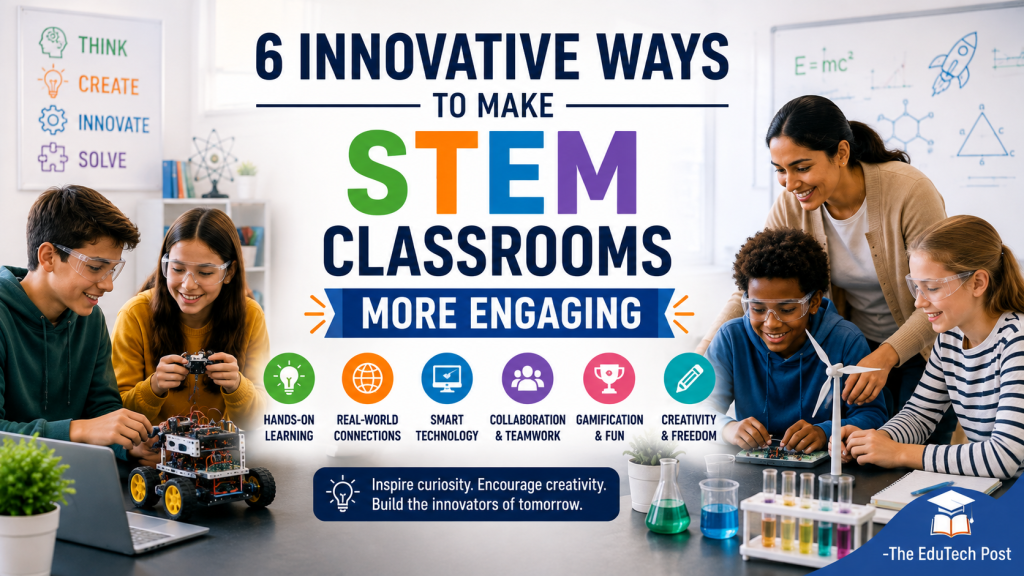
STEM education is changing rapidly. Students today need more than textbooks and lectures to understand science, technology, engineering, and mathematics. They need opportunities to experiment, build, question, collaborate, and solve problems. Creating engaging STEM classrooms can make these subjects more interactive while helping students develop skills they can use beyond school.
Here are six innovative ways educators can make STEM learning more engaging.
1. Make Learning Hands-On
One of the simplest ways to increase student engagement is to let students learn by doing. Instead of explaining every concept theoretically, teachers can introduce experiments, design challenges, models, and prototypes.
For example, students learning about engineering could build a bridge using limited materials and then test how much weight it can support. A science class could investigate water filtration by designing and testing different filtration systems.
Hands-on activities turn abstract concepts into experiences students can see and understand.
2. Connect STEM to Real-World Problems
Students are more interested in learning when they understand why a concept matters.
Teachers can introduce real-world challenges involving climate change, renewable energy, healthcare, transportation, space exploration, or cybersecurity. Students can then investigate the problem and develop possible solutions.
For example, a class studying renewable energy could design a small solar-powered device. This approach allows students to apply scientific and mathematical concepts while thinking about problems that affect the world around them.
3. Bring Technology Into STEM Lessons
Technology can make difficult STEM concepts easier to explore and visualize. Technology is transforming modern science classrooms through virtual labs, simulations, robotics, and other digital tools.
A physics student might use a simulation to explore motion, while a computer science student could build a simple program. Robotics projects can combine coding, engineering, mathematics, and problem-solving in one activity.
The goal is not to use technology simply because it is available. Digital tools should have a clear purpose and help students explore concepts more effectively.
4. Encourage Collaborative Projects
STEM learning does not have to be an individual activity. Group projects can encourage students to communicate, share ideas, and approach problems from different perspectives.
Teachers can divide students into small teams and give each group a STEM challenge. Students might design a sustainable building, develop a simple app, construct a robot, or analyze environmental data.
Collaboration also reflects the way STEM professionals work. Scientists, engineers, programmers, and researchers often depend on teamwork to solve complex problems.
5. Use Gamification to Make STEM Fun
Games and friendly challenges can turn an ordinary STEM lesson into an exciting learning experience.
Teachers can use coding challenges, STEM quizzes, design competitions, puzzles, escape-room activities, and classroom challenges to encourage participation. Gamification in education can make these activities more interactive by using challenges, rewards, and friendly competition to motivate students. Students could compete to build the strongest structure, solve a problem in the shortest time, or complete a coding challenge.
Gamification can also provide immediate feedback, helping students understand mistakes and try again without feeling discouraged.
6. Give Students Freedom to Create
Creativity is an important part of STEM, yet students are sometimes given very limited opportunities to make their own decisions.
Teachers can provide a problem and allow students to choose how they want to solve it. One group might create a physical prototype, another could develop a digital solution, while another might use data to present its findings.
Giving students this freedom encourages curiosity, creativity, and ownership. Instead of simply following instructions, students become active problem-solvers.
Why Engaging STEM Classrooms Matter
Creating engaging STEM classrooms is about more than making lessons entertaining. It helps students develop critical thinking, creativity, communication, collaboration, and problem-solving skills.
These skills are increasingly important as technology continues to change the workplace. Students who learn to experiment, adapt, and find solutions can become better prepared for future academic and career opportunities.
Engagement can also help students develop greater confidence in STEM subjects. When students are encouraged to ask questions and learn from failure, they may become more willing to tackle challenging problems.
The Future of STEM Learning
The future of STEM education will likely combine innovative technology with hands-on and student-centered learning. Artificial intelligence, robotics, virtual environments, and other emerging technologies can create new opportunities for exploration.
However, technology alone cannot create an engaging classroom. Teachers remain essential in designing meaningful activities, encouraging curiosity, providing feedback, and helping students connect classroom concepts to real-world situations. By combining hands-on activities, real-world challenges, technology, collaboration, gamification, and creativity, educators can build STEM classrooms where students are not just learning about STEM—they are actively doing STEM.
Final Thoughts
Making STEM learning more engaging does not require completely changing the curriculum. Even small changes can make a significant difference. A simple experiment, an interesting challenge, a collaborative project, or an opportunity to create something from scratch can transform the learning experience. With the right approach, engaging STEM classrooms can inspire students to become curious thinkers, creative innovators, and confident problem-solvers.