







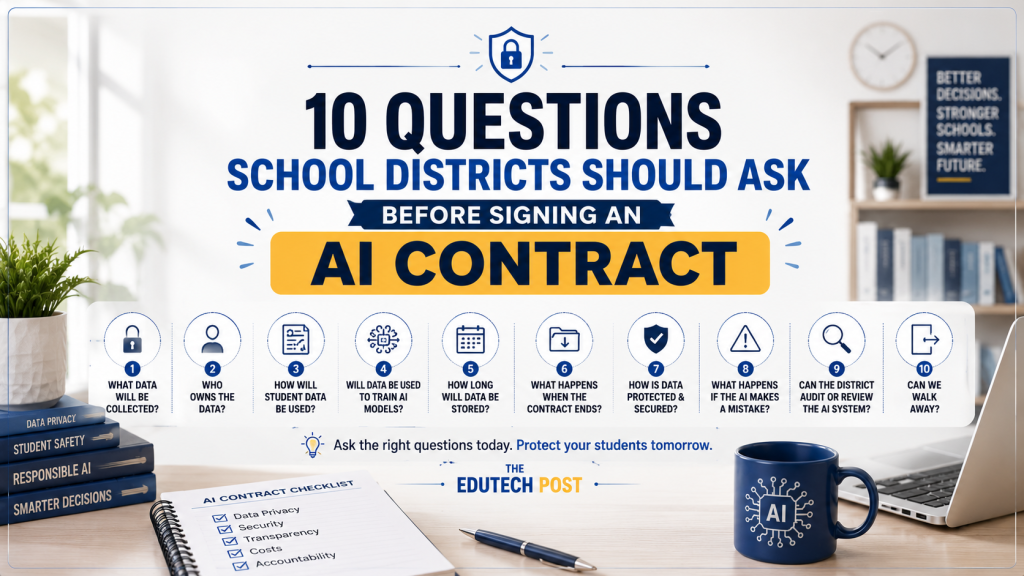
The use of AI in classrooms is expanding rapidly, but school districts shouldn’t allow this to influence how quickly they make purchases. Before signing AI contracts for school districts, administrators need to look beyond impressive demos and ask what happens to student data, who controls the technology, how much it will really cost, and what happens when something goes wrong.
An AI tool may promise personalized learning, faster grading, better tutoring, or less administrative work. But once a district signs a contract, that tool can become deeply connected to student records, teacher workflows, and school systems.
The right questions need to come before the signature—not after a problem appears.
Why AI Contracts Deserve More Scrutiny
Buying an AI platform is different from buying an ordinary piece of software.
An AI system may process student information, generate recommendations, analyze writing, interact directly with children, or make decisions that influence learning. That makes the vendor agreement particularly important.
The U.S. Department of Education’s Student Privacy Policy Office advises schools to ensure that third-party services handling personally identifiable information remain under the school’s direct control and do not use or redisclose education data for unauthorized purposes.
In other words, the contract isn’t just paperwork. It is part of the district’s protection strategy.
Here are 10 questions every district should ask before signing.
1. What Student Data Will the AI Tool Collect?
Start with the simplest question: What exactly does this system need to know about our students?
A vendor may request names, grade levels, assignments, writing samples, behavioral information, voice recordings, or other data. This is why digital literacy and cybersecurity for students are becoming increasingly important as schools expand their use of technology. District leaders should ask for a clear list of every data element collected.
The goal should be data minimization: if the AI tool can perform its job without certain information, that information should not be collected.
The Department of Education’s privacy guidance also emphasizes collecting only the information needed for the service being provided.
2. Who Owns the Data?
Never assume that uploading information to an AI platform means the district automatically retains complete control over it.
Ask the vendor:
- Who owns student-generated content?
- Who owns teacher-created materials?
- Can the vendor reuse the information?
- Can the vendor sell or share it?
- What rights does the district retain after the contract ends?
These answers should be clearly written into the agreement—not buried in a general privacy policy.
3. Will Our Data Be Used to Train AI Models?
This question deserves special attention.
A vendor might use customer data to improve its products or train future models. That may sound harmless until the district considers what could happen when student work or other sensitive information becomes part of a broader AI-development process.
Ask directly:
“Will any district or student data be used to train, fine-tune, test, or improve your AI models?”
If the answer is yes, ask exactly what information is used, whether it is anonymized, who can access it, and whether the district can opt out. A vague answer should be a warning sign.
4. How Long Will the Vendor Keep Student Data?
Data retention should have a clear end date.
Districts should know:
- How long information is stored
- Where it is stored
- What happens to backups
- When data is deleted
- Whether deletion includes copies held by subcontractors
The contract should also explain what happens when the district stops using the platform. The Department of Education notes that appropriate agreements can establish responsibilities around protecting and ultimately destroying protected information when it is no longer needed.
5. What Happens to the Data When the Contract Ends?
This is where many procurement conversations stop too early. A district may have a smooth experience for two years and then decide to switch vendors. What happens to its data then?
Ask whether the vendor will:
- Return district data in a usable format
- Permanently delete its copies
- Delete backups within a defined period
- Provide written confirmation of deletion
- Assist with transferring data to another system
A district should not feel trapped because leaving an AI platform is technically difficult.
6. How Does the Vendor Protect Student Information?
AI adoption can introduce new cybersecurity and privacy risks. The Department of Education specifically warns that online applications and services can introduce security vulnerabilities into school or district systems.
District technology teams should therefore ask about:
- Encryption
- Access controls
- Authentication
- Security monitoring
- Employee access to student information
- Incident response
- Third-party vendors
- Data breach notification
Don’t settle for “We take security seriously.”
Ask for the actual contractual commitments.
7. What Happens If the AI Makes a Mistake?
AI systems can generate incorrect or misleading information.
That becomes more serious when an AI tool is used to recommend interventions, evaluate student work, provide feedback, identify struggling learners, or support decisions about students.
Districts should ask:
When something goes wrong with the system, who is in charge?
The contract should make clear whether teachers or administrators remain responsible for reviewing AI-generated outputs and how errors can be reported and corrected.
AI should support professional judgment—not quietly replace it. This is also why the debate around teachers vs. AI matters as schools decide where human judgment should remain essential.
8. Can the District Audit or Review the AI System?
A district shouldn’t have to take a vendor’s claims at face value.
Ask whether the district can review:
- Data-use practices
- Security documentation
- Subprocessors
- System performance
- Accessibility
- Bias or fairness testing
- Significant changes to the AI model
Also ask what happens if the vendor changes its technology after the contract is signed. An AI contract written for today’s system may not adequately protect the district if the product changes substantially next year.
9. What Are the Real Costs?
The subscription price is only part of the financial picture.
District leaders should calculate the total cost of ownership, including:
- Implementation
- Integration
- Training
- Technical support
- Additional licenses
- Data migration
- Premium AI features
- Renewal increases
- Early termination fees
A low-cost pilot can become an expensive district-wide commitment once every school, teacher, and student is included. Before signing, ask the vendor to put all foreseeable costs in writing.
10. Can We Walk Away?
Perhaps the most important question is also the one procurement teams sometimes overlook:
“What happens if we decide this AI tool isn’t working for our district?”
Look carefully at cancellation terms, renewal periods, notice requirements, data portability, termination fees, and vendor obligations after termination.
The district should have a realistic exit strategy. A good AI contract should not make leaving the platform harder than entering it.
A Simple AI Contract Checklist for School Districts
Before signing, district leaders should be able to answer “yes” to the following:
- We know exactly what student data the AI tool collects.
- The contract clearly defines data ownership and permitted use.
- AI model training and data reuse are explicitly addressed.
- Data retention and deletion requirements are written into the agreement.
- Security responsibilities are clearly defined.
- Breach notification requirements are included.
- Subcontractors and sub processors are disclosed.
- AI-generated decisions can be reviewed by qualified humans.
- Total costs and renewal terms are understood.
- The district has a practical exit and data-transfer plan.
The Department of Education identifies written agreements as a best practice for clarifying third-party responsibilities and protecting FERPA-covered information.
Don’t Let the AI Demo Make the Decision
A polished AI demonstration can make a product look irresistible. But a 20-minute demo doesn’t tell a district what happens to student data three years later.
That’s why procurement teams should evaluate the contract as carefully as the technology. The most impressive AI platform isn’t necessarily the best choice if its data practices, security commitments, costs, or exit terms don’t work for the district.
AI can offer enormous opportunities for schools. But responsible adoption starts with something much less exciting than a flashy demo: asking difficult questions before signing.
For school districts, the best AI contract isn’t necessarily the one that gets the newest technology into classrooms fastest. It’s the one that protects students, gives educators appropriate control, and leaves the district confident about what it is agreeing to—today and years from now.
Note: This article provides general educational information, not legal advice. Districts should have qualified legal, privacy, procurement, and IT professionals review AI agreements against applicable federal, state/provincial, and local requirements.